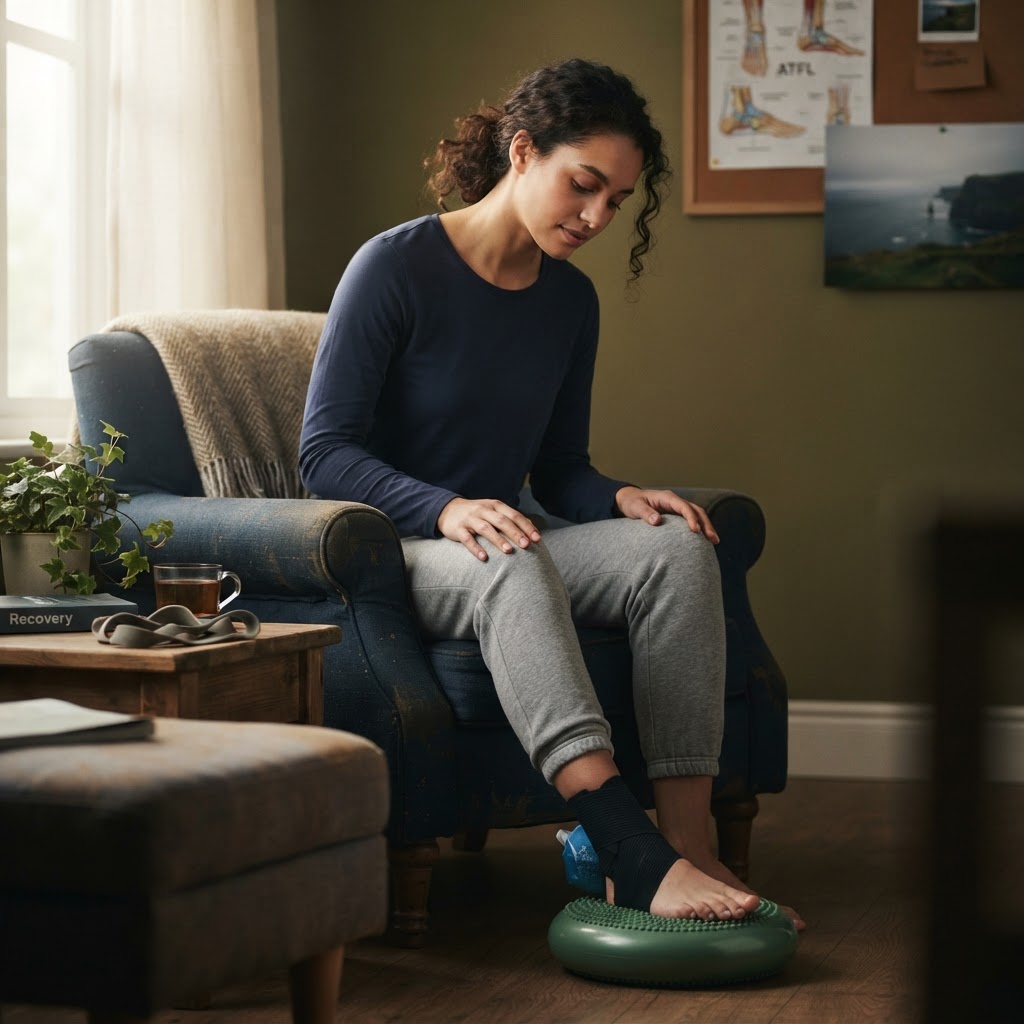
The Most Common Injury in Irish Sport
Ankle sprains are the most frequent injury in Irish sport. GAA, soccer, rugby, hurling, basketball, and athletics all produce ankle sprains by the thousand each year. But despite their frequency, ankle sprains are often poorly managed — and the consequences can last for years.
The truth is: an ankle sprain is a ligament injury, and ligaments need specific care to heal properly. Simply resting and waiting isn't enough.
Understanding the Ankle Ligaments
The ankle is stabilised by three lateral ligaments and a medial ligament complex:
- Anterior talofibular ligament (ATFL): The most commonly injured, it limits forward movement of the foot on the leg
- Calcaneofibular ligament (CFL): Limits sideways tilting of the ankle
- Posterior talofibular ligament (PTFL): Limits backward movement
- Deltoid ligament: The strong medial ligament that limits outward rolling
Most sprains (80%+) are inversion sprains — the foot rolls inward, damaging the ATFL first, then the CFL in more severe cases.
Why the RICE Protocol Isn't Enough
RICE (Rest, Ice, Compression, Elevation) was the standard advice for decades. It reduces initial swelling and pain — but it doesn't address the real problem: the damaged ligament needs to heal in the right position, with the right tension, and with restored proprioception.
Here's what RICE misses:
- Ligament positioning: The torn ligament ends need to be guided back into alignment. Complete rest lets them heal in a stretched position.
- Proprioception: Ankle sprains damage the position-sensing nerves in the ligaments. Without retraining, you'll keep re-spraining.
- Progressive loading: Ligaments need controlled stress to heal strong. Too much rest weakens them.
- Functional movement: Walking, running, and cutting need to be gradually reintroduced.
The Metacognitive Recovery Approach
Stage 1: Protection and Positioning (0-72 hours)
- Protect the ankle from further injury, but don't immobilise completely
- Gentle range of motion (alphabet exercises with the foot) guides ligament healing
- Compression and elevation manage swelling
- Feel the damage: Where exactly is the pain? Front of the ankle (ATFL), side (CFL), or back (PTFL)? This tells you which ligament is injured.
Stage 2: Restoration (3-14 days)
- Gradual weight-bearing as pain allows
- Active range of motion in all directions
- Begin proprioception exercises (single-leg balancing)
- Feel the stability: When you stand on the injured ankle, can you feel it wobbling? That's the proprioceptive deficit. Retraining it is essential.
Stage 3: Rebuilding (2-6 weeks)
- Progressive resistance (resistance bands, calf raises)
- Dynamic balance exercises (wobble board, single-leg squats)
- Sport-specific movement (gentle cutting, hopping)
- Feel the chain: When you walk, can you feel the force travel through the ankle? Is it smooth or does the ankle collapse inward?
Stage 4: Return to Sport (6+ weeks)
- Full sport-specific training
- Plyometric loading (jumping, hopping)
- Gradual return to competition
- Feel confidence: Do you trust the ankle? If not, you're not ready. Psychological readiness matters.
The Proprioception Factor
The most overlooked aspect of ankle recovery is proprioception — your body's ability to sense where the ankle is in space. The ligaments contain position sensors that tell your brain the ankle's position. When they're damaged, this sense is impaired.
Without retraining proprioception, the ankle doesn't know when it's about to roll again. This is why 40% of people who sprain their ankle once will sprain it again — the position sense was never restored.
Proprioception Exercises
- Single-leg balance: Start with eyes open, progress to eyes closed
- Wobble board: Builds ankle stability in all directions
- Single-leg squats: Trains the ankle, knee, and hip to work together
- Hopping: The ultimate test of ankle confidence
The Irish Sporting Context
- GAA: Cutting and pivoting on uneven pitches
- Soccer: Landing after headers, cutting on firm ground
- Rugby: Tackling and being tackled creates rotational ankle forces
- Cross-country and trail running: Ireland's trails and fields produce uneven surfaces
Action Steps
- Grade the sprain: Mild (can walk), moderate (can't hop), severe (can't bear weight). This guides your recovery intensity.
- Start early movement: Gentle alphabet exercises (drawing letters with your foot) begin within 24 hours.
- Progress weight-bearing: Don't rush to full walking. Let pain guide the progression.
- Retrain proprioception: Single-leg balance is the foundation. Do it daily.
- Strengthen the chain: The ankle, knee, and hip work together. Strengthen all three.
- Feel the ankle: Throughout recovery, notice how the ankle feels during movement. Your body's feedback is your best guide.
The Mindset Shift
An ankle sprain feels minor — "just a rolled ankle" — but improper recovery creates years of instability and re-injury. By treating the sprain with the respect it deserves, understanding the ligament damage, and retraining the proprioception, you transform a common injury into an opportunity for deeper body awareness.
Your ankle ligaments will heal. The question is whether they heal strong and aware, or weak and vulnerable. That's in your hands — or rather, in your awareness. Every balance exercise, every graded progression, every moment of feeling the ankle's position is an investment in a stable future.
Don't let a simple sprain become a recurring cycle. Engage with the recovery, feel the ligaments healing, and return to movement stronger than before.
PAIN APPLICATION — WHAT WOULD WE MEASURE?
This is a measurement example, not a case study. No individual's recorded data appears here.
For a single-leg loading task, an assessment may record:
- the reported pain score
- Sensor Sling pressure where relevant
- pressure distribution
- angle/orientation where supported
- timing
- sequence
- repeatability
- loading
- movement response
The process is the same as for any I AM 900 assessment:
ESTABLISH BASELINE → MEASURE → CHANGE INPUT → RETEST → COMPARE
Sensor Sling measurement does not diagnose sprain severity, ligament tears or any specific ankle pathology — and pressure measurements do not identify which structure causes pain.
Why Retesting Matters in Pain: What Changed From Baseline? sets out how the comparison works.