

Where you feel it is one piece of the picture.
Pain tells you where something is being felt. It doesn't always tell you everything about how the body is moving around it.
The Pain Is the Signal. The Story May Start Somewhere Else.
Pain tells you where something is being felt. It doesn't always tell you everything about how the body is moving around it. I Am 900 looks beyond the painful area — observing movement, timing and selected measurements across the connected body.
900
Ligaments
Mapped
1
Connected
Body
1
Method
Three
Pathways
Specific pain determines the Dossier and assessment pathway. The wider connected-body response remains part of the I AM 900 methodology.
Select Your Pain Region
13-page pain-specific 900 dossier · instant PDF download
↑ Select your pain region above to build your specific 900 Dossier
Secure payment · 30-day money-back guarantee
Two Ways In
Start Free or Start Specific.
Two different entry points — choose what fits where you are right now.
Entry 1 · Free
Free Scan Analysis
Upload your scan or report. Tell us where you feel it. We review and point you to the appropriate next step — no cost, no obligation.
Entry 2 · €39
Pain-Specific Dossier
Select your pain region and build your specific 900 Dossier. 13 pages observing the connected-body response — not just the painful area. Instant PDF download.
MOVEMENT LEAVES CLUES.


Pain · Movement / Loading
BASELINE → MEASURE → CHANGE
→ RE-TEST → COMPARE
Establish how the person currently moves and loads. Measure relevant observable movement and sensor information. Introduce the practitioner-directed change. Repeat the comparable measurement. Compare what changed.
BASELINE
Establish how the person currently moves and loads.
MEASURE
Record relevant observable movement and sensor information.
CHANGE
Introduce the practitioner-directed programme or change.
RE-TEST
Repeat the relevant comparable measurement.
COMPARE
Compare what changed. A measured difference does not establish the cause of pain.
The Loop
Practitioner Actions
Software does not make diagnostic conclusions automatically. The practitioner reviews the comparison and sets the next programme.
900
Ligaments Mapped
1
Connected Body
13
Pages — Movement Dossier
I AM 900 Recorded Outcomes
Results, Measured Not Promised.
Sport
22%
AVERAGE RECORDED IMPROVEMENT OVER THREE WEEKS
I AM 900 recorded athlete outcomes show an average 22% improvement over three weeks.
The result is based on change recorded between I AM 900 baseline and retest measurements.
Individual results vary.
The Sport pathwayPain
50%
AVERAGE RECORDED IMPROVEMENT IN REPORTED PAIN OVER THREE WEEKS
I AM 900 recorded Pain outcomes show an average 50% improvement in reported pain over three weeks.
The result is based on the change in reported pain between baseline and reassessment.
Reported pain is a separate dataset from physical Sensor Sling measurements — the Sensor Sling does not directly measure pain.
Individual results vary.
The Pain pathwayHow We Measure Change
BASELINE
We establish the starting point.
↓
MEASURE
We record the relevant response.
↓
CALIBRATE
We change the input.
↓
RETEST
We repeat the assessment.
↓
COMPARE
We compare the result with baseline.
We measure the response.
These figures are I AM 900 recorded outcomes — internal platform data based on baseline and retest comparison. They are not published clinical research, not independent clinical trials and not guaranteed results.
How We Measure It
One Measurement Language. Three Instruments.
Every I Am 900 reading is built from the same measurement vocabulary — and every reading is compared against the individual's baseline.
Sensor Sling
Distributed pressure sensed through the fabric-supported Sling, plus the Sling's integrated sensor measurements — angle, movement and repeatability.
Pressure Mat
Ground and contact pressure during movement, including left and right loading.
Platform
Synchronises and compares the measurements, so baseline and retest always refer to the same reference points.
Compare what changed
Free Scan Analysis
Upload your scan or report. Tell us where you feel it. We'll review what you send and point you to the appropriate next step. No cost, no obligation.
Where do you feel it? Select your pain region.
See Inside Before You Buy
Flip through three pages from the dossier. Enter your email to unlock the self-assessment page — free.
What Your Ligaments Really Do
Your Body's Tension Network
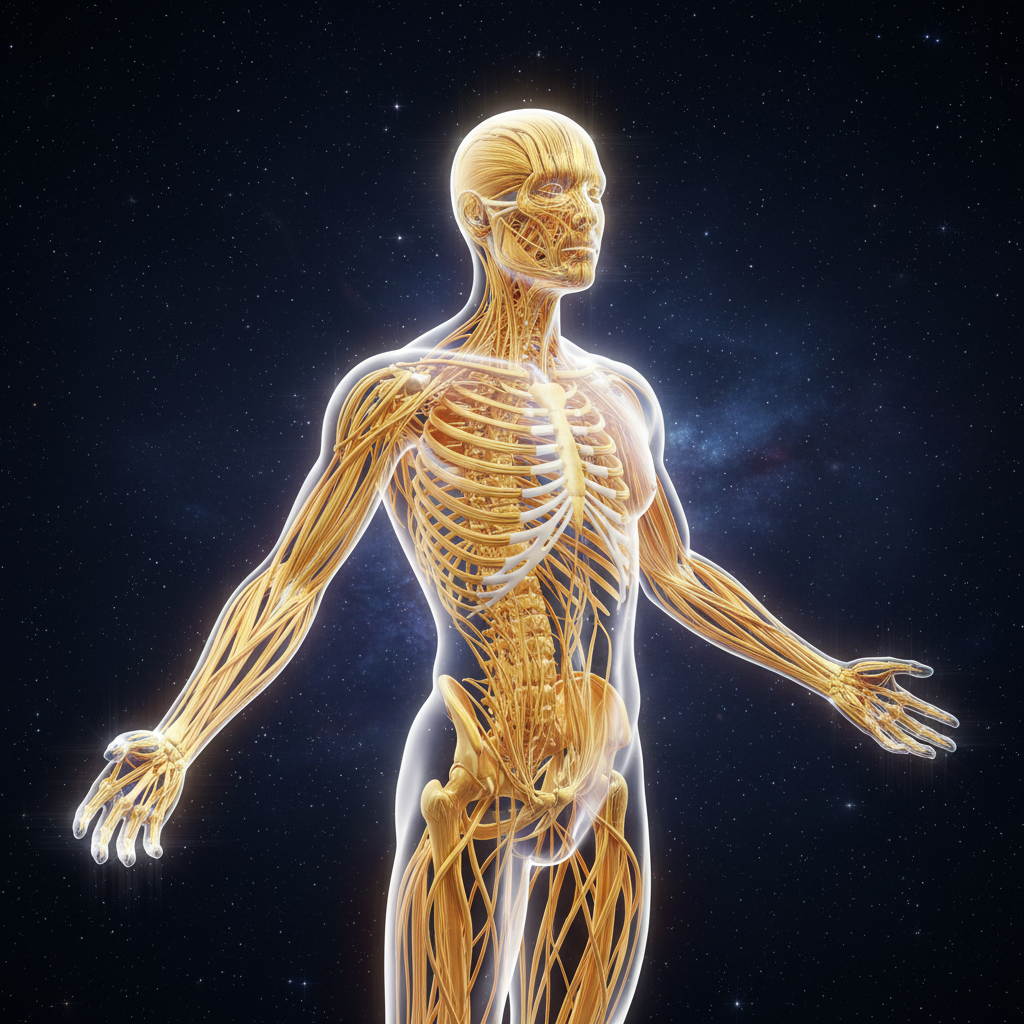
Most people think of ligaments as simple straps that hold bones together. They are far more than that. Ligaments are your body's tension network — a living web of connective tissue that transmits force, stabilises joints, and tells your nervous system where your body is in space.
Every movement you make depends on ligaments doing their job. When they're healthy and tensioned correctly, you move with power and ease. When they're tight, weak, or locked, you move with compensations — and eventually, pain.
The Chain Principle
Ligaments don't work in isolation. They work in chains. The tension in your foot ligaments travels up through your ankle, calf, knee, hip, pelvis, and spine. A problem in one link affects every link above and below it.
"Your body is not a collection of parts. It is a continuous tension network — and your ligaments are the wires that hold it together."
Who Built This
Not a Theory. A Lived System.
I Am 900 began with a single sensor sling and a body that wasn't getting better. It grew into a method for observing movement, measuring responses and investigating how the body connects. This is not a fitness program or a medical diagnosis — it is a different way of looking at the body.
Built From Practice
I Am 900 grew out of hands-on remedial work — observing bodies, exploring movement and investigating how different areas relate.
900 Ligaments Mapped
A framework that places the ligament system at the centre of how we observe movement, pressure and physical response across the body.
A Different View
Not a diagnosis. Not a replacement for medical care. A different way of observing how the body moves and responds.
The Dossier gives us your starting picture.
The Latency Test takes the assessment live. We observe the delay between the instruction to move and the body's observable movement response — exploring movement timing, micro movement and selected pressure responses across the connected body.
- Observes movement timing and response across the connected body
- Explores the delay between the instruction to move and the body's observable response
- A personalised report outlining the principal observations from your session
€99 · live video assessment
From the Clinic in Kells
16 Years. Tens of Thousands of Chains Read.
I Am 900 grew out of hands-on remedial practice. These are personal accounts from people who experienced the method at the clinic in Kells, County Meath. Individual experiences are not a guarantee of outcomes.
"Went in with a knee that had been locked up for two seasons. Came out understanding it was never the knee — it was the chain below it. Played a full championship within three months."
Declan M.
Gaelic footballer · Meath minor panel
"Every physio I saw taped the same IT band and sent me home. This was the first person who traced it to my ankle and showed me why. I haven't missed a session since."
Sinead R.
Runner · Kells AC
"I'd given up on working without pain. Six weeks after the first session I was back on site full-time. The method is different because it actually finds where the problem lives."
Ciaran F.
Builder · chronic back pain 6 years
"Tore my hamstring twice in a year doing the same rehab. This approach found the chain that was loading it wrong. No re-tear in 18 months now."
Aoife B.
Camogie player · Kilmessan
"Spent thousands on scans and injections that did nothing. One session here told me more about my own body than every specialist combined. Wish I'd found it years ago."
Tom L.
Farmer · slipped disc recovery
"I thought it was just stress and posture. Turns out the chain ran from a old ankle injury I'd forgotten about. The relief was almost immediate once we addressed the right thing."
Niamh K.
Teacher · shoulder & neck pain
Research & Evidence
The Evidence, Clearly Labelled.
Everything on this page falls into one of three categories. We label them separately so you always know what is our recorded data, what is published research, and what is our measurement process.
1 — I Am 900 Recorded Outcomes
22%
Average recorded improvement over three weeks — Sport
50%
Average recorded improvement in reported pain over three weeks — Pain
Any outcome figure shown on this page — such as the 50% average improvement — is an I Am 900 recorded outcome: the average improvement in reported pain over a 3-week calibration block. Reported pain is a separate dataset from physical sensor measurements. This is internal platform data, not independent, peer-reviewed clinical research. Individual results vary.
Individual results vary.
2 — External Published Research
- Moseley GL, Butler DS. Fifteen Years of Explaining Pain: The Past, Present, and Future. The Journal of Pain, 2015.
- National Institute for Health and Care Excellence (NICE). Chronic pain (primary) in adults: NG193, 2021.
Listed for general context only. These findings belong to their authors — they are not I Am 900 data, and I Am 900 does not claim them.
3 — I Am 900 Methodology / Measurement Process
Recorded outcomes are not where the system starts. Measurement is — Measure → Calibrate → Retest — supported by the operational backbone: Establish the baseline. Measure the response. Change the input. Retest. Compare what changed.
Read the MethodDon't Chase the Pain. Investigate the Movement.
A painful area deserves attention. But knowing where it hurts doesn't tell us everything about how the body moves. Start with the dossier.
Instant download · 30-day guarantee