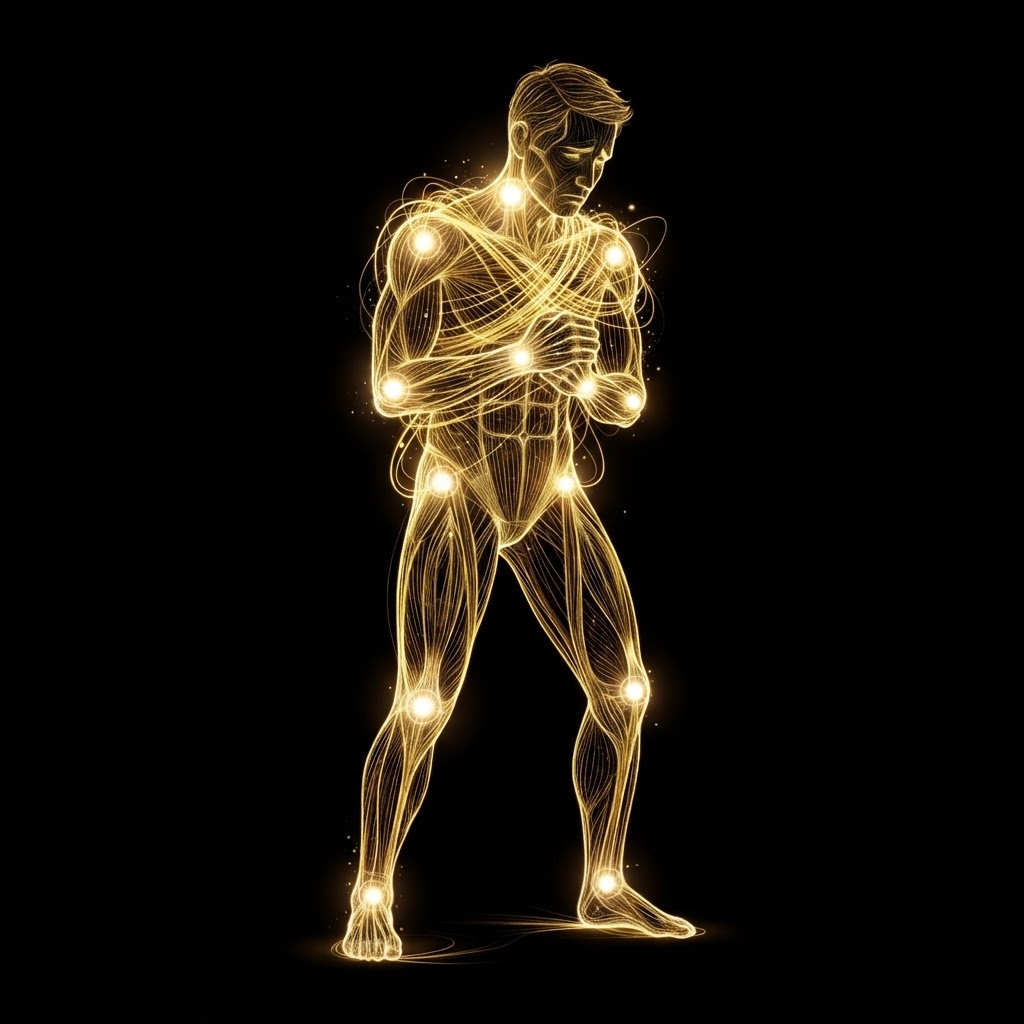

There is a kind of pain that does not match the scan. The MRI is clean. The tissue has healed. The surgeon says the repair was successful. And still, years later, the body aches in the place where the injury happened. The weather changes and the old fracture site sings. The body moves a certain way and something deep in the joint flinches. This is not poor healing. This is a ligament still holding the trauma.
The Body Keeps the Record
Modern medicine treats trauma as an event that ends when the tissue closes. A torn ligament is repaired or reconstructed. A fracture is set. The cast comes off. Rehabilitation strengthens the surrounding muscle. The injury is declared healed.
But the body does not experience trauma as an event. It experiences it as a pattern. The moment of injury — the impact, the fall, the collision — is recorded not only in the torn tissue but in the entire chain that absorbed the force. The ligament that tore is one link. The force that tore it passed through every link above and below it. Each of those links registered the load. Each of them, in its own way, locked down to protect the body from a force that was too great to dissipate.
When the torn ligament heals, the lock does not automatically release. The chain stays braced. The nervous system, which experienced the trauma as a threat to survival, keeps the surrounding ligaments on high alert — held tight, ready for the next impact that never comes. That holding pattern is the trauma. It lives in the chain long after the tissue has closed.
Why the Scan Is Clean but the Pain Remains
This is why so many people live with pain that imaging cannot explain. The scan shows a healed ligament. It does not show the tension the ligament is still holding. It does not show the four other ligaments in the chain that braced during the impact and never unclenched. It does not show the neurological guard that keeps the entire region tight against a threat that ended years ago.
The pain is real. The source is invisible to a scan because the source is not structural damage. It is a holding pattern — a ligament chain that is still protecting the body from a moment that has already passed.
The Chain and the Trauma Signal
In the I Am 900 system, every ligament chain has a signal volume — a way of describing how loudly the chain is still speaking about an old trauma. A muted chain is one that has gone quiet, often after years of guarding. The ligaments have shut down so completely that the body no longer registers the region at all. This is the old injury that does not hurt but never moves right — the shoulder that has not reached overhead in a decade, the ankle that still turns on uneven ground, the neck that will not rotate fully to one side.
A screaming chain is the opposite. The ligaments are still holding the trauma so tightly that every movement through the region triggers the alarm. This is the old injury that aches in the cold, flinches under load, and never lets you forget it happened.
Both are the same phenomenon. The chain has not released the trauma. It has only expressed it differently.
Why Strength and Stretching Do Not Release the Trauma
The standard approach to an old injury is to strengthen the muscles around it and stretch the tight tissues. Both can provide temporary relief. Neither releases the trauma. Strengthening the muscles around a guarded ligament gives the body more capacity to compensate for the holding pattern — but the pattern itself remains. Stretching a ligament that is holding trauma pulls against a neurological guard. The guard fights back. The tissue tightens again the moment the stretch ends.
This is why people spend years in and out of physiotherapy for the same old injury. They are managing the compensation. They are not releasing the pattern.
Releasing the trauma requires a different kind of work. It requires teaching the nervous system, link by link, that the threat has passed. It requires loading each ligament in the chain at a tension that says this is safe now — not enough to trigger the guard, enough to let it down. This is calibration. It is slow, deliberate, and it works in the order the chain was designed to carry force.
The Chain Remembers What the Mind Has Forgotten
There is a reason old injuries ache on anniversaries, in certain weather, or in moments of stress. The ligament chain recorded the trauma at a level below conscious memory. It recorded the angle of the impact, the position of the body, the direction of the force. When conditions echo that original moment — a drop in barometric pressure, a similar movement pattern, a surge of stress hormones — the chain replays the guard. It braces for an impact that already happened.
This is not imagination. It is the structural memory of a body that survived something it could not fully process. The mind moved on. The chain did not.
From Holding to Release
The path out of a held trauma is not to force the chain open. It is to give it permission to let go. Each checkpoint is loaded in sequence, at a tension the nervous system can accept without re-triggering the guard. The chain learns, link by link, that the load is safe. The guard drops. The ligament that has been bracing for years finally unclenches. The force that was trapped in the pattern begins to flow through the chain again.
When the chain releases the trauma, the old injury does not just stop hurting. It stops being an injury. It becomes a part of the body's history rather than a part of its present. The scar remains. The story does not.
The I Am 900 system reads the trauma held in the ligament chain and calibrates each checkpoint until the guard releases. Request an assessment if an old injury is still holding you.