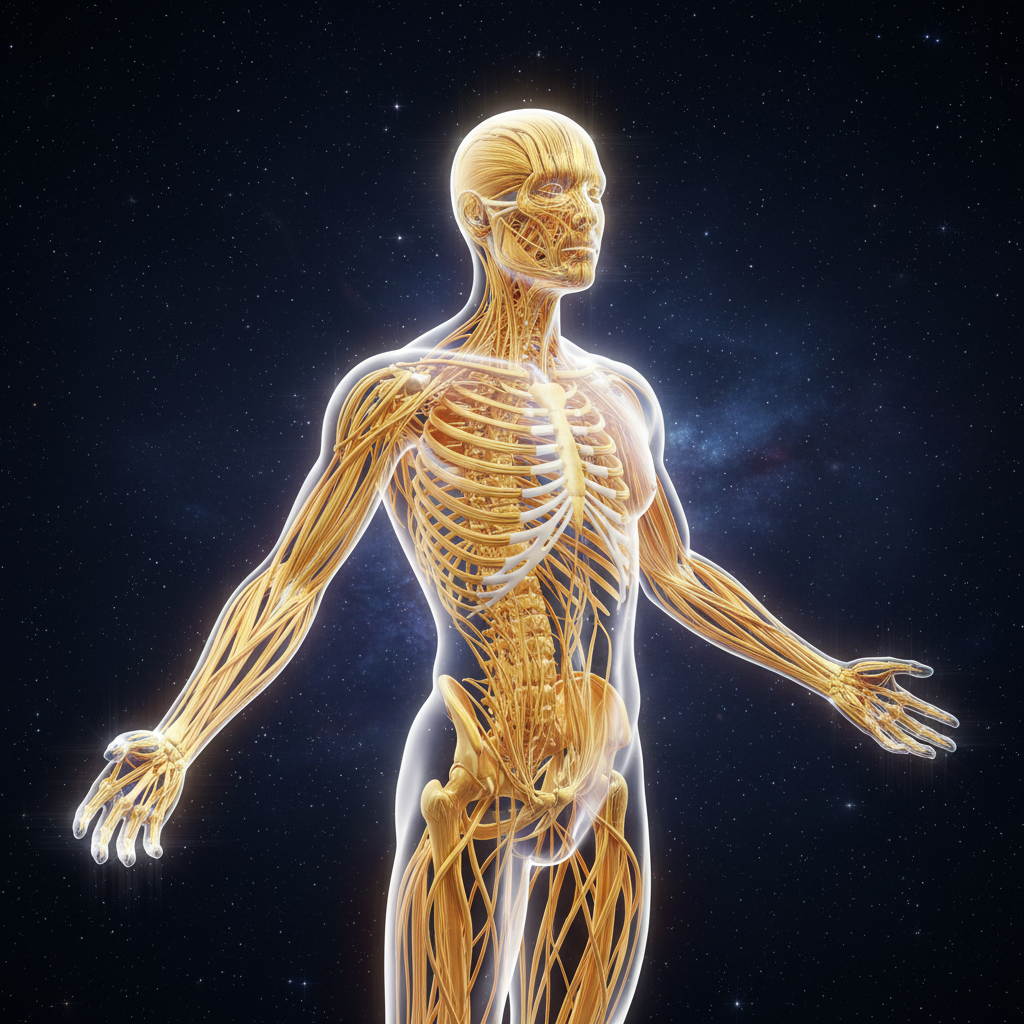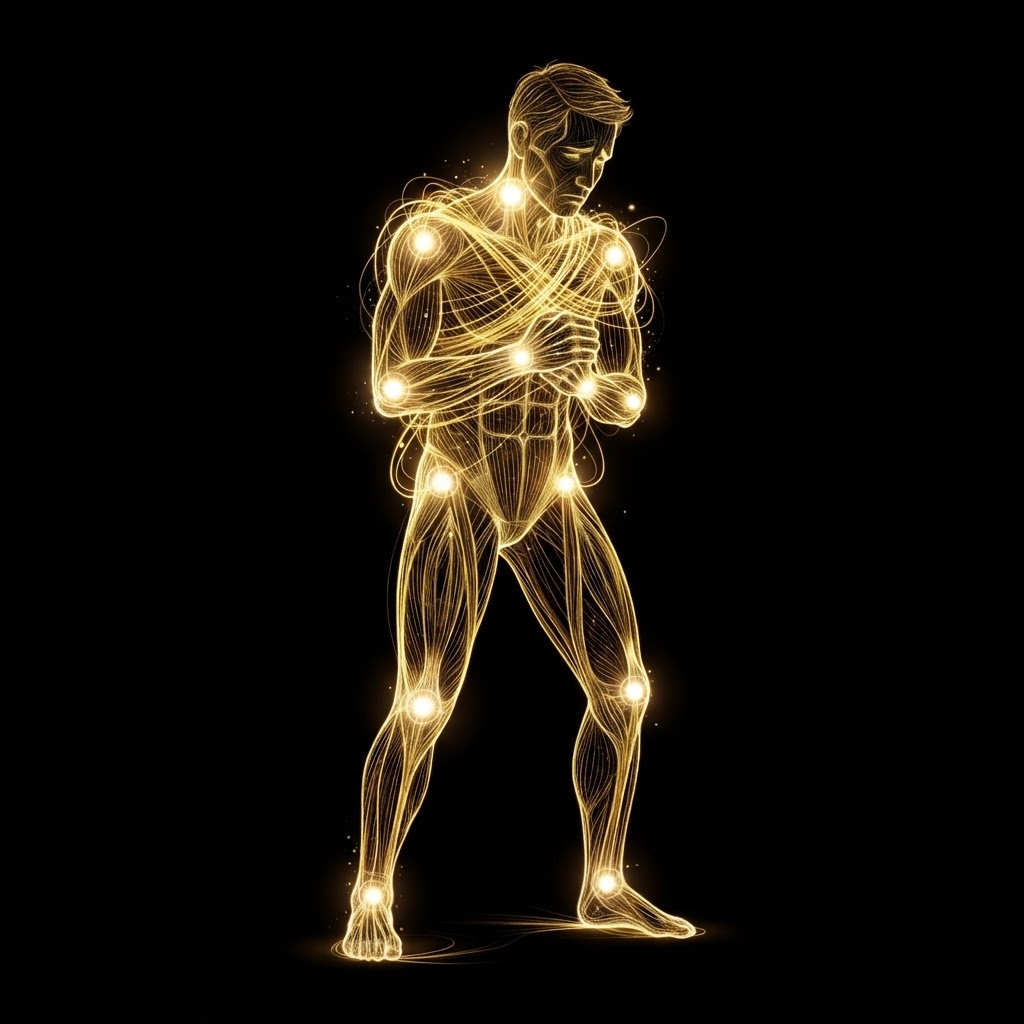
The Body Can Respond Before You Have the Words
After a fall, an impact, a twist or another sudden event, the body can produce physical responses that are visible from the outside — before, and sometimes without, an explanation in words. Someone may describe guarding a shoulder, hesitating before a cut, or moving differently, without being able to say exactly why.
I AM 900 begins where the words often are not yet: with what can be physically observed and measured. Rather than requiring someone to explain everything first, the assessment starts with the body's observable response to a defined movement task. Questions provide context. Measurement provides a starting record. Neither replaces the other.
This is not a diagnosis of the event and not a diagnosis of the person's experience of it. It is a measurement of physical response — taken so that there is something concrete to compare against later.
What a Physical Response Can Look Like
During a defined task — a step, a reach, a rotation, a landing — the body may show patterns such as:
- Pressure distribution — how weight sits across the measured zones during the task
- Loading — how force is applied into the ground or the support surface
- Movement strategy — which movement the body chooses to complete the task
- Timing — when each part of the movement begins and ends
- Sequence — the order in which segments of the body join the movement
- Repeatability — whether the same response appears across repeated attempts
- Asymmetry — where measured, differences between left and right
- Changes between attempts — whether the response shifts as attempts continue
Many of these are commonly described as protective movement patterns — the body organising itself to limit load in a region. Recording the pattern does not explain its cause. A guarded pattern can be observed without concluding what produced it.
What the Sensor Sling Actually Measures
The I AM 900 Sensor Sling is a fabric-supported measurement instrument. During a task it records:
- pressure and pressure distribution at the supported sensor locations
- sensor-zone response — how pressure shifts between zones during the movement
- angle and orientation, where supported
- timing and sequence of measured events
- speed / rate of change, where supported
- repeatability across attempts
Separately, a pressure mat records ground and contact loading and pressure distribution at the feet or contact surface. These are two different instruments measuring two different things, and both can feed the same assessment picture.
Neither instrument measures ligament strain directly. The Sling records what the body does at the measured locations during the measured task — no more, and no less.
Measurement Is Not Diagnosis
This boundary is fixed:
- Measurements show what the body is doing during the measured task — nothing more.
- They do not independently tell us why the body is doing it.
- They do not diagnose psychological trauma.
- They do not read memories or emotions.
- I AM 900 does not diagnose trauma, and the Sensor Sling does not detect trauma.
The measurements describe response. Understanding what a response means — for recovery, for training, for return to activity — is a process of comparison over time, not a single reading.
The Questions Still Matter
Measurement is one half of the picture. Context is the other. Before or alongside the measurements, the conversation can cover:
- what happened
- when it happened
- what changed afterwards
- which movements feel different now
- what the person notices in their own movement
- what they want to regain
These questions are asked openly and without leading. The person's account is treated as context for the measurements — never as a diagnosis, and never as a conclusion about cause.
Build the Baseline
Before anything changes, the process records a baseline: the same task, the same setup, the same measurement, repeated until the response is stable.
A single reading describes one moment. A repeatable baseline describes a starting condition — something that can be compared against later with confidence. Why we establish a baseline before asking what needs to change sets out the reasoning in full.
Change the Input
From the baseline, the input changes — a calibration input drawn from the Calibration process. This is a physical input to a physical task, applied within the boundaries of the method.
What it is not: a treatment of psychological trauma, a claim about undoing the past, or a diagnosis of any kind. The input is changed so that the response can be observed again, under the same measurement conditions.
Retest the Same Response
The process follows the same sequence every time:
BASELINE → MEASURE → CHANGE THE INPUT → RETEST → COMPARE WHAT CHANGED
The retest uses the same task, the same setup and the same measurements as the baseline. Why re-testing matters explains how the comparison turns two readings into information.
The Gap Is the Information
The information sits in the difference between baseline and retest. If a measured response shifts after the input changed, that difference is a recorded, comparable fact about the response to the changed input.
It is not proof of cause. A measured gap shows that something changed under a changed input — it is not interpreted here as anything more than what was measured.
You Don't Need to Know What to Say Before We Start
You do not have to arrive knowing exactly what is wrong or how to describe it.
We can start with what your body is doing now. Measure it. Change the input. Retest it. Compare what changed.
Measurement builds part of the picture. Your experience provides the context.
Explore the Trauma pathway, the method behind it, or read more in the trauma article library.
For the applied layer — how the observable response is measured after an event, without interpreting it psychologically — see Protective Movement After Trauma: What Can We Measure?.