The Athlete Who Got Stronger and Still Broke
He did everything right. Gym three mornings a week. Squats heavy, hamstrings loaded, glutes fired, core braced. Stronger than he had ever been. Then his knee gave way on a harmless change of direction — the same knee that had been surgically repaired two years earlier and pronounced fully healed.
This is the pattern that haunted my first decade in clinical practice. The stronger they got, the more confident they became, and the more violently the joint eventually failed. For years I blamed the training. The truth was older, and harder to face: the joint had never forgotten the injury. It had simply forgotten the reflex.
The Reflex No One Trains
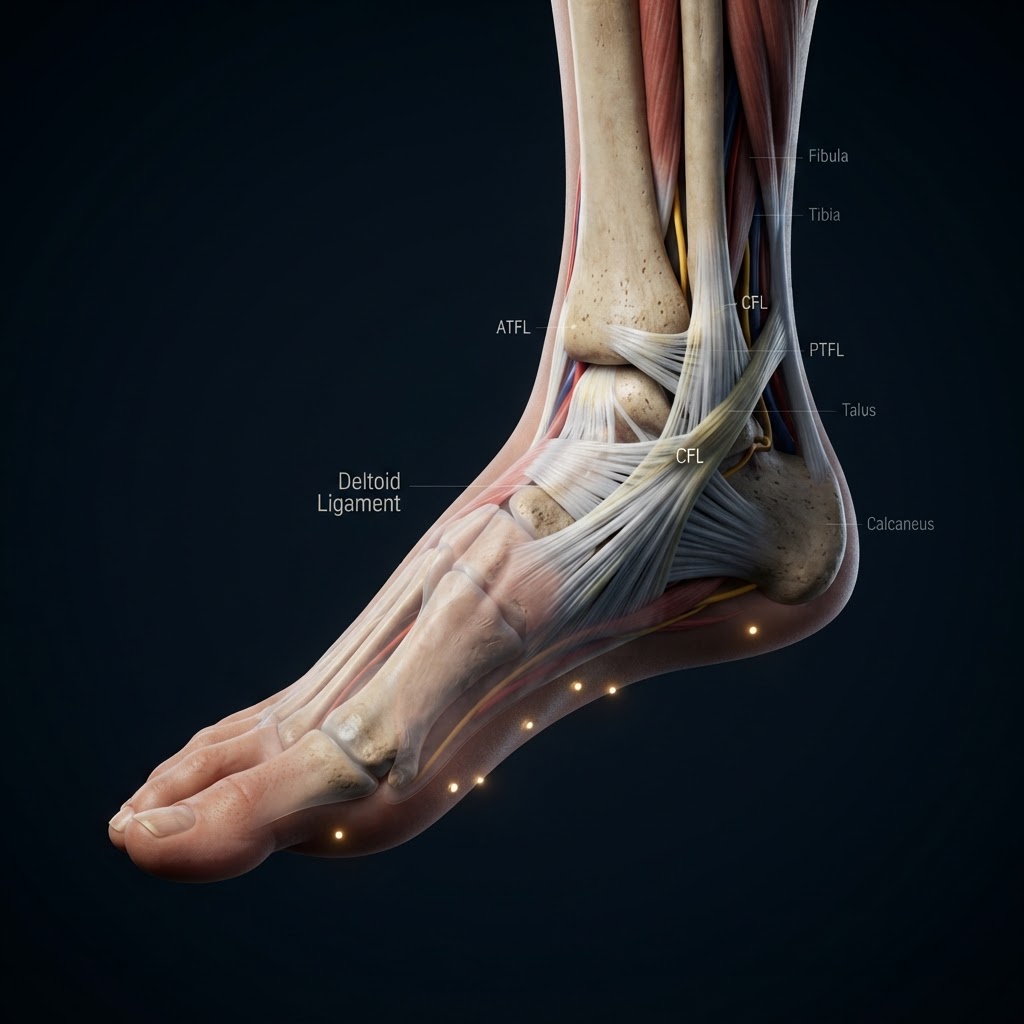
Every healthy ligament carries a reflex arc — a fraction-of-a-second conversation between the tension sensor in the ligament and the muscles that surround the joint. The moment the joint is perturbed, the ligament fires a signal, the muscles contract, and the joint is protected before you are even consciously aware of the threat. This is not strength. This is not coordination. This is reflex — older than thought, faster than decision, the body's first line of defence.
Stretch a ligament — in an injury, in a surgery, in years of compensating around an old restriction — and that reflex goes quiet. The joint no longer knows it is in danger until it is too late. The muscles are strong. The joint is stable on a scan. But the conversation that once protected the joint in milliseconds has fallen silent.
Why Strength Alone Makes It Worse
Strength without reflex is a heavier load travelling through a joint that no longer feels when it is being threatened. You are building a more powerful engine for a car whose brakes no longer respond until after the crash. This is why athletes who pass every strength test still tear the same ligament twice. We measured the wrong thing. We celebrated force production and ignored reflex integrity.
The First Measurable Loss
In twenty years I have learned that reflex loss is not invisible. It shows up as latency — the milliseconds between perturbation and protective contraction. A healthy ligament fires in tens of milliseconds. A stretched, guarded, or neglected ligament fires late, or not at all. That delay is the single most reliable predictor of re-injury I have ever measured — far more than strength, far more than range of motion, far more than pain.
The Work of Restoring the Conversation
You cannot strengthen a reflex. You cannot stretch a reflex. You cannot talk a reflex back into existence. You have to restore the tension in the ligament that generates it, then retrain the joint under real speed until the conversation resumes. Measure the latency. Restore the tension. Re-expose the joint to the speeds and angles of real sport. The reflex returns, and the joint stops breaking — not because it got stronger, but because it remembered how to protect itself.
A strong joint with a silent reflex is a loaded gun with the safety off. Restore the reflex, and strength finally becomes safe.