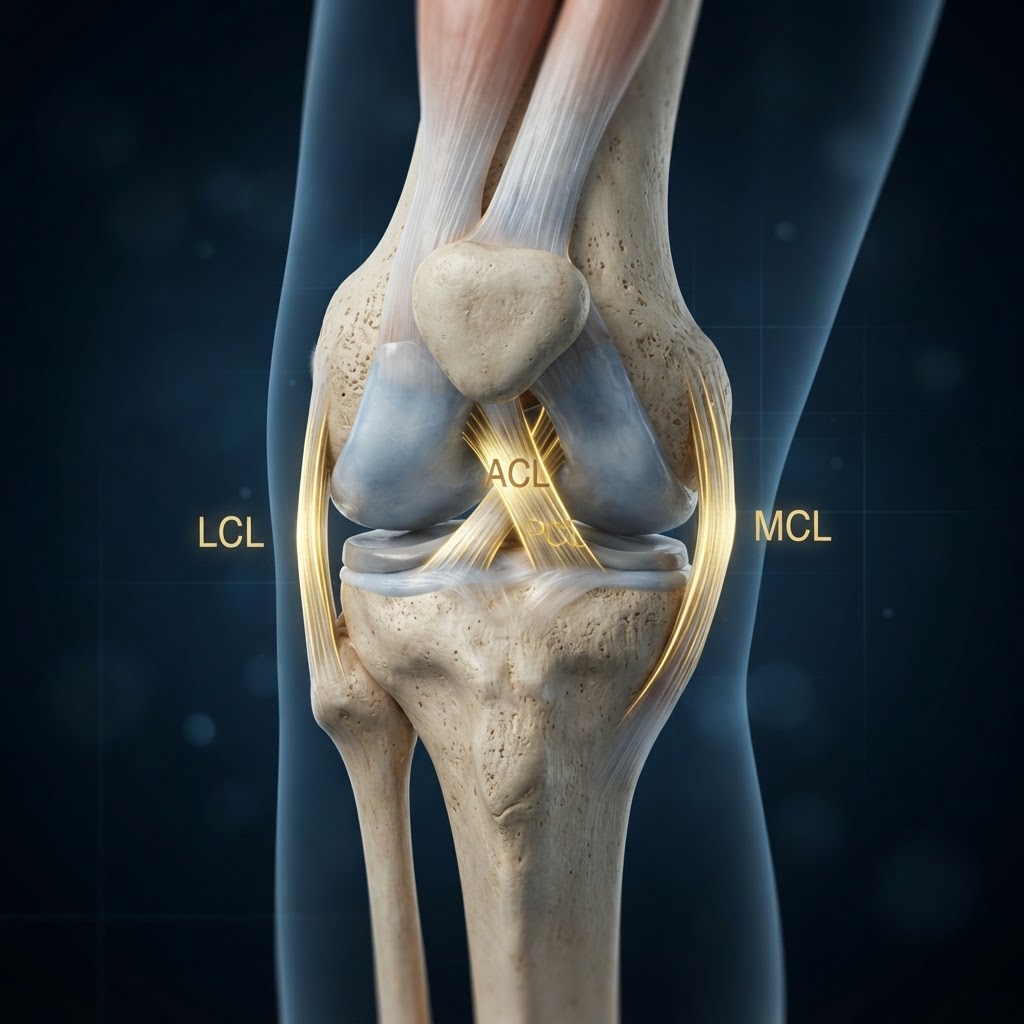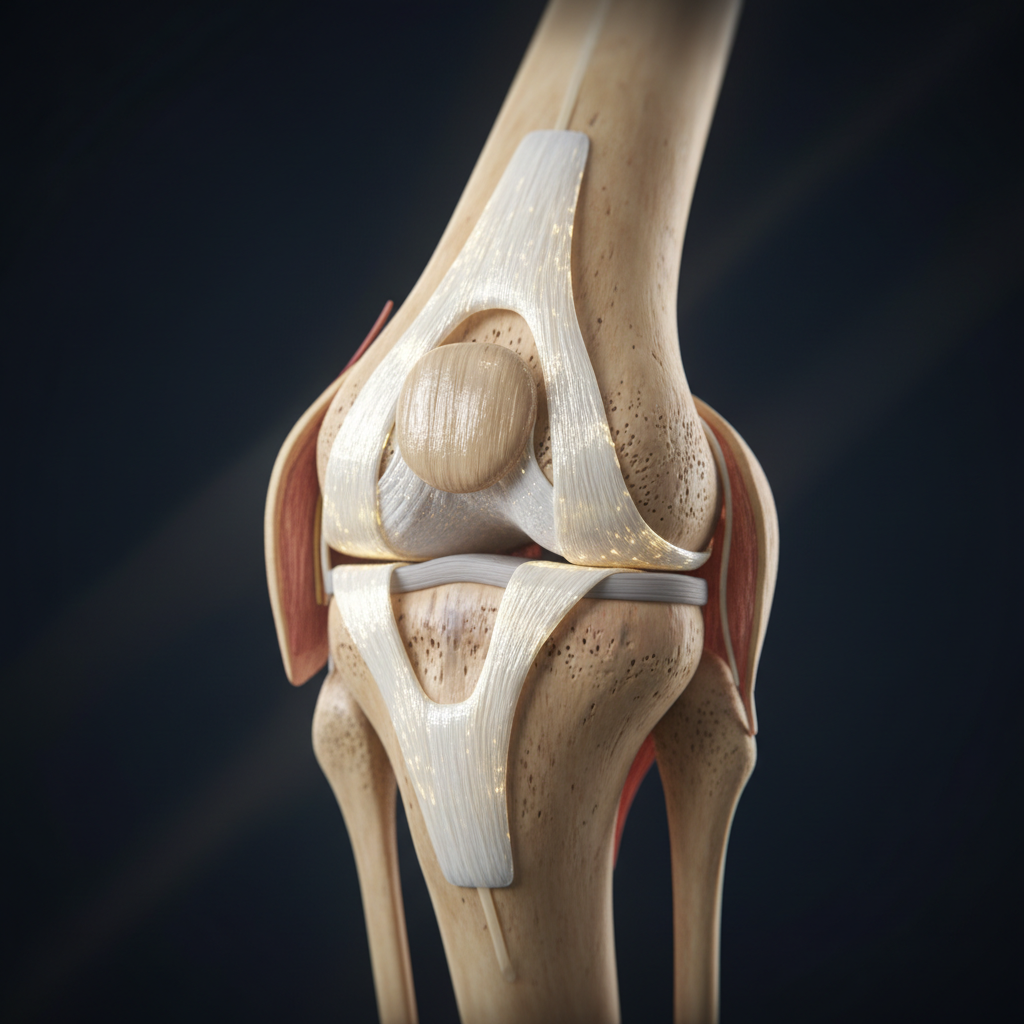

Every athlete who has ever planted a foot and changed direction knows the moment. The body commits, the ground grips, and for a fraction of a second the entire structural load of a sprinting body passes through one joint. In that fraction of a second, the difference between a clean cut and a torn ACL is not strength. It is not speed. It is the integrity of a chain.
The Chain, Not the Muscle
For decades, sports performance has been built on a muscle-first model. We measure squat numbers, deadlift totals, and sprint times. We strengthen the quads, the glutes, the hamstrings. And then an athlete plants a foot on a perfectly dry pitch and tears a ligament anyway. The muscle was strong. The ligament was not ready. The chain failed.
The body is not a collection of muscles pulling on bones. It is a continuous chain of ligaments, fascia, and connective tissue that transfers force from the ground up through the foot, the ankle, the knee, the hip, the pelvis, and the spine. Every one of the 900 ligaments in the human body is a link in that chain. When the chain is intact, force flows. When a single link is underperforming — stretched, scarred, or neurologically muted — the force does not stop. It reroutes. It dumps into the next joint, the next ligament, the next structure that was never designed to carry it.
This is how athletes tear ACLs with no contact. The knee did not fail because it was weak. The knee failed because a link lower in the chain — an ankle ligament that never fully recovered from an old sprain — was leaking force sideways instead of driving it forward. The knee inherited a load it was never meant to absorb alone.
The 23-Checkpoint Map
The I Am 900 system maps the body's ligament chain across 23 structural checkpoints, from the arch of the foot to the Atlas at the base of the skull. Each checkpoint is a named ligament complex with a specific role in force transfer. Each one can be read — not through an MRI, but through movement. The way you walk, squat, land, and change direction tells the story of which links are intact and which are leaking.
When an athlete comes in for a chain audit, we do not ask which muscle is weak. We ask which checkpoint is holding the line and which one is quietly offloading it. A knee that collapses inward on a single-leg landing is not a knee problem. It is an ankle-chain problem that the knee is paying for. A hip that drops on a sprint stride is not a glute weakness. It is a pelvic-chain ligament that has lost its tension reference.
Why Strength Alone Cannot Fix the Chain
You cannot strengthen a ligament the way you strengthen a muscle. Ligaments do not contract. They hold. They set the line that muscles pull against. If the ligament's line is off — even by a few millimetres — every muscle attached to that joint pulls against a crooked frame. The body gets strong in the wrong position. It gets powerful along the wrong line. And then, the first time it meets an unpredictable load — a cut, a landing, a collision — the chain breaks at its weakest link.
This is why athletes who lift enormous weights still tear ligaments. They built strength on a frame that was already leaking. The chain was never calibrated.
Calibrating the Chain
Calibration is the process of restoring each ligament's tension reference so the chain transfers force in a straight line again. It is not stretching. It is not strengthening. It is the deliberate, progressive loading of each checkpoint in sequence — foot to ankle, ankle to knee, knee to hip — until the entire chain holds the same line under the same load.
The I AM 900 Sensor Sling was built for exactly this. Each Sling measurement maps to a checkpoint. Each protocol loads the chain in the order it was designed to carry force. The athlete does not get stronger in the gym sense. They get structurally honest. The force goes where it is supposed to go.
The Practical Protocol
A chain calibration session follows a fixed sequence. It begins at the foot — the first checkpoint to touch the ground — and works upward. The athlete loads the ankle complex in a controlled sagittal plane, then introduces rotational demand only when the sagittal line holds clean. The knee is loaded next, never in isolation, always as the link between the ankle below and the hip above. If the knee wobbles, the answer is never to strengthen the knee. The answer is to return to the checkpoint below it and restore the line the knee was depending on.
This is why so many knee rehabilitation programmes fail. They treat the knee as the problem. They strengthen the muscles around it. They never look downstream at the ankle that has been feeding it bad information for years. The knee gets stronger. The chain stays broken. The athlete returns to sport and tears the same ligament, or a different one, because the leak was never sealed.
The Athlete Who Already Knows
If you have ever felt that your body is strong but something is off — that you are fast but not stable, powerful but not reliable — you are already reading the chain. You are feeling a link that is leaking. The question is not whether you can strengthen your way out of it. The question is whether you can calibrate the chain before it breaks.
The chain decides who cuts and who tears. The athletes who understand this are the ones still playing at forty. The ones who do not are the ones on the surgeon's table at twenty-five, wondering how a strong body broke so easily.
The answer was never in the muscle. It was always in the chain.
The I Am 900 system maps 900 ligaments across 23 structural checkpoints. Request an assessment to find out which link in your chain is leaking before it breaks.