The Tensegrity Model: Why Your Muscles Are Only As Explosive As Your Ligaments
The human body is not a stack of levers. It is a tensegrity structure — a continuous web of bones floating in tension, held together by ligaments, tendons, and fascia. The word comes from tensional integrity: the bones do not bear load by compression alone. They are suspended in a network of connective tissue that distributes force across the entire structure.
This is the foundational principle behind the I Am 900 system. There are roughly 900 ligaments in the human body, and together they form the tension network that governs every explosive movement you make.
Why Standard Training Misses the Network
Most training isolates muscles and loads them progressively. But in a tensegrity structure, a weak link anywhere in the network changes the force path through the entire system. You can build the strongest glutes in the world — if the sacrotuberous ligament anchoring your pelvis is slack, that force leaks out of the chain before it ever reaches the ground.
Why Your Muscles Can't Protect an Unstable Joint
Muscles are reactive. They fire after the nervous system detects load — there is always a latency. Ligaments, by contrast, are proactive. They are pre-tensioned wires that hold the joint aligned the instant force arrives. If the ligament is lax, the joint wobbles for those critical milliseconds before the muscle catches it. That wobble is the window where power leaks and injuries happen.
No amount of muscle hypertrophy closes that window. Only restoring the ligament's tension does.
The 900-Ligament Blueprint
We divide the body's ligament network into functional chains:
- The Cervical Chain — stabilises the neck and governs upper-body force transfer.
- The Spinal Chain — the iliolumbar and supraspinous ligaments anchor the lumbar column.
- The Pelvic Chain — the sacrotuberous and sacroiliac ligaments transfer force from spine to legs.
- The Knee Chain — the ACL, MCL, and LCL manage rotational and lateral shear.
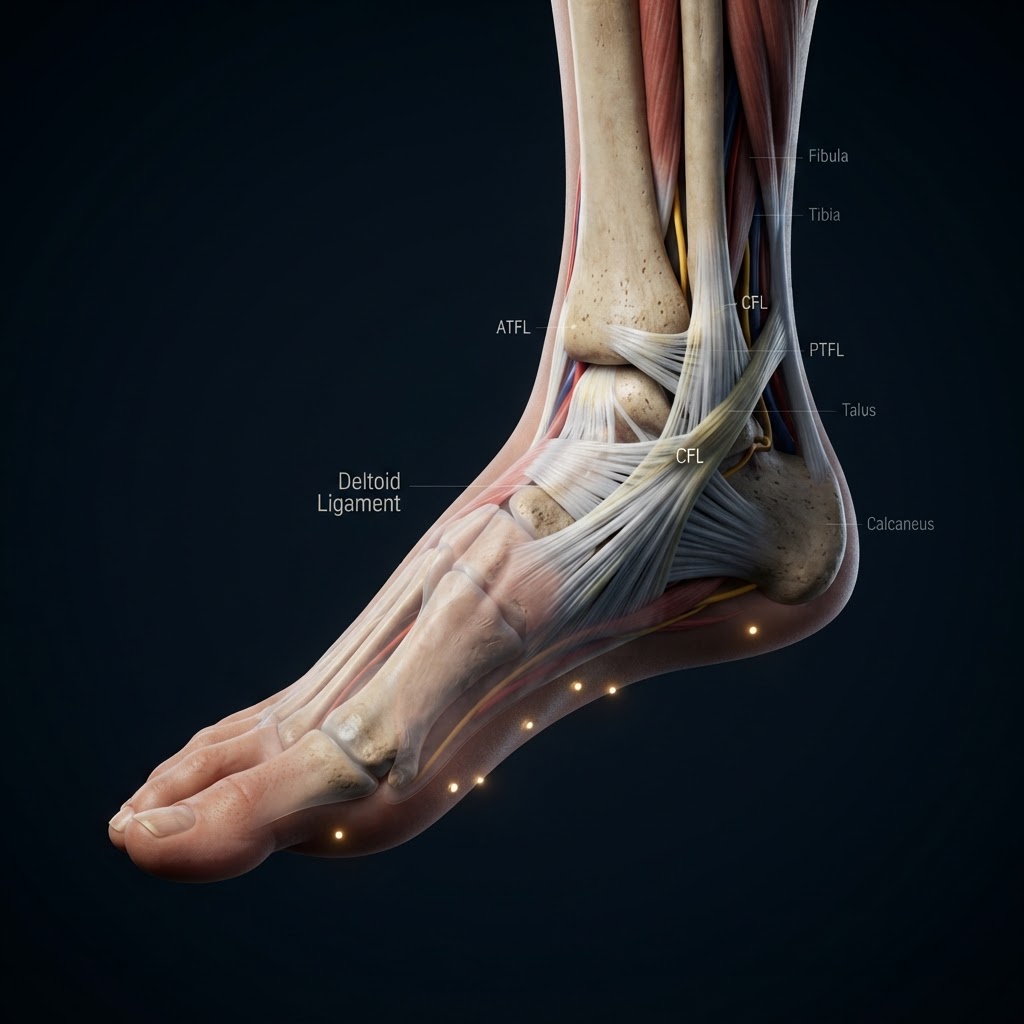
- The Ankle Chain — the ATFL and CFL govern ground contact and cutting stability.
- The Shoulder Chain — the glenohumeral ligaments stabilise the throwing and lifting arc.
Each chain is a continuous tension line. A deficit in one radiates up and down the structure.
How We Measure the Network
This is the core of the 900 system. Fabric pressure sensors in the sling read the tension at each chain in real time. A latency assessment measures how quickly your nervous system detects and corrects force through each chain. Together, these two measurements reveal exactly where your tensegrity has gone slack — and exactly where your 20% is hiding.
The Takeaway
You cannot out-train a structural deficit. You can only re-tension the network that carries your power. Measure the chains. Re-tension the ligaments. Watch the 20% return.