The Muscle Myth
Walk into any gym and you'll see athletes building the engine — bigger quads, stronger hamstrings, more powerful glutes. But there's a problem nobody talks about: an engine is only as good as its transmission.
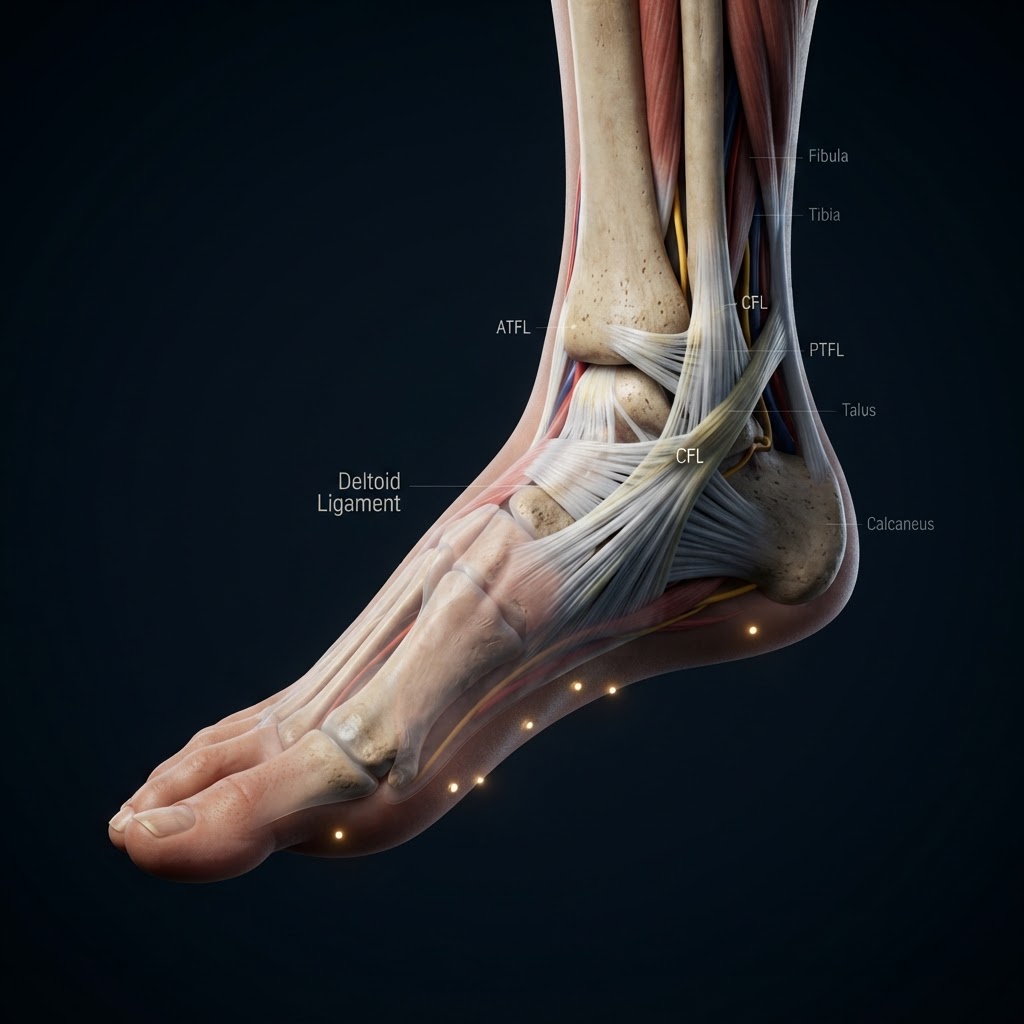
Ligaments are the transmission of the human body. They connect muscle to bone, bone to bone, and transfer every ounce of force your muscles generate into the ground, the ball, the opponent. If your ligaments can't handle the load, your muscles are producing power that goes nowhere — or worse, into injury.
What the Research Shows
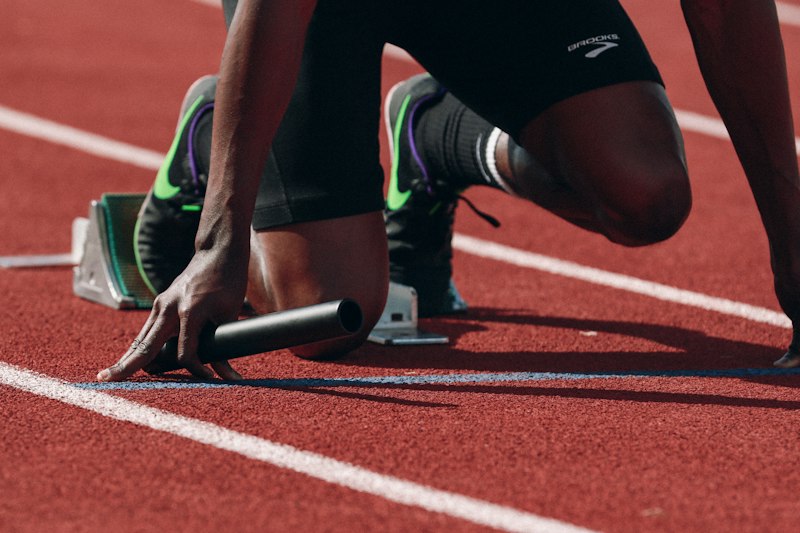
Sprint performance depends heavily on tendon and ligament stiffness — the ability of the connective tissue to store elastic energy and release it like a coiled spring. This property is widely discussed in published movement-science research as part of the stretch-shortening cycle; it is general scientific context, not validation of any specific system.
This is called the stretch-shortening cycle, and it's the single most important physical quality in nearly every explosive sport: sprinting, jumping, cutting, throwing, striking. The stiffer and more responsive your ligaments, the more free speed you get from every movement.
The Problem with Conventional Training
Most training programmes build muscle and assume ligaments will follow. They don't — or at least, not fast enough. Muscle tissue adapts in weeks. Ligament tissue adapts in months. That gap is where injuries live.
An athlete who adds 15% to their squat in eight weeks has ligaments that are still at baseline. They're now generating 15% more force through tissue that hasn't caught up. That's why so many injuries happen after a strength block — the muscles are ready, the ligaments aren't.
Training the Ligament
Ligament training isn't about lifting heavier. It's about exposing connective tissue to specific, progressive loads that force adaptation. The key principles:
1. Isometric loading
Long-duration holds — 30 to 45 seconds — under tension teach ligaments to stiffen and adapt. Think wall sits, Nordic holds, planks with deliberate tension through the chain.
2. Eccentric emphasis
The lowering phase of movement is where ligaments do their hardest work. Slow eccentrics — 4 to 6 seconds down — build the capacity of tendons and ligaments to absorb force.
3. Plyometric progression
Once the tissue can absorb force, you teach it to release it. Bounding, depth jumps, and reactive drills build the stretch-shortening cycle — but only after weeks of isometric and eccentric preparation.
4. Chain awareness
A ligament never works alone. When you train the ACL, you're also training the MCL, the patellar tendon, the IT band, and the entire kinetic chain from foot to hip. Isolated work misses the point. Chain work builds the system.
The Sensor Difference
This is where the I Am 900 system changes the game. Pressure sensors in the sling detect exactly how much load each ligament is under during movement. You don't guess whether your ligaments are ready for the next progression — you know. You can see when the left chain is compensating for the right, when the ankle is offloading the knee, when the system is about to break down.
That data turns ligament training from a guessing game into a precision process. You train the right tissue, at the right load, at the right time. And the results speak: faster sprints, sharper cuts, more explosive jumps — all from tissue that most athletes never deliberately train at all.
The Takeaway
If you're an athlete and you've never thought about your ligaments, you're leaving performance on the table. The strongest muscle in the world is useless if the tissue connecting it can't transfer the force. Train the ligament. Train the chain. And watch your performance jump — not because you got stronger, but because you finally started using the strength you already had.