Speed Is Easy. Agility Is Hard.
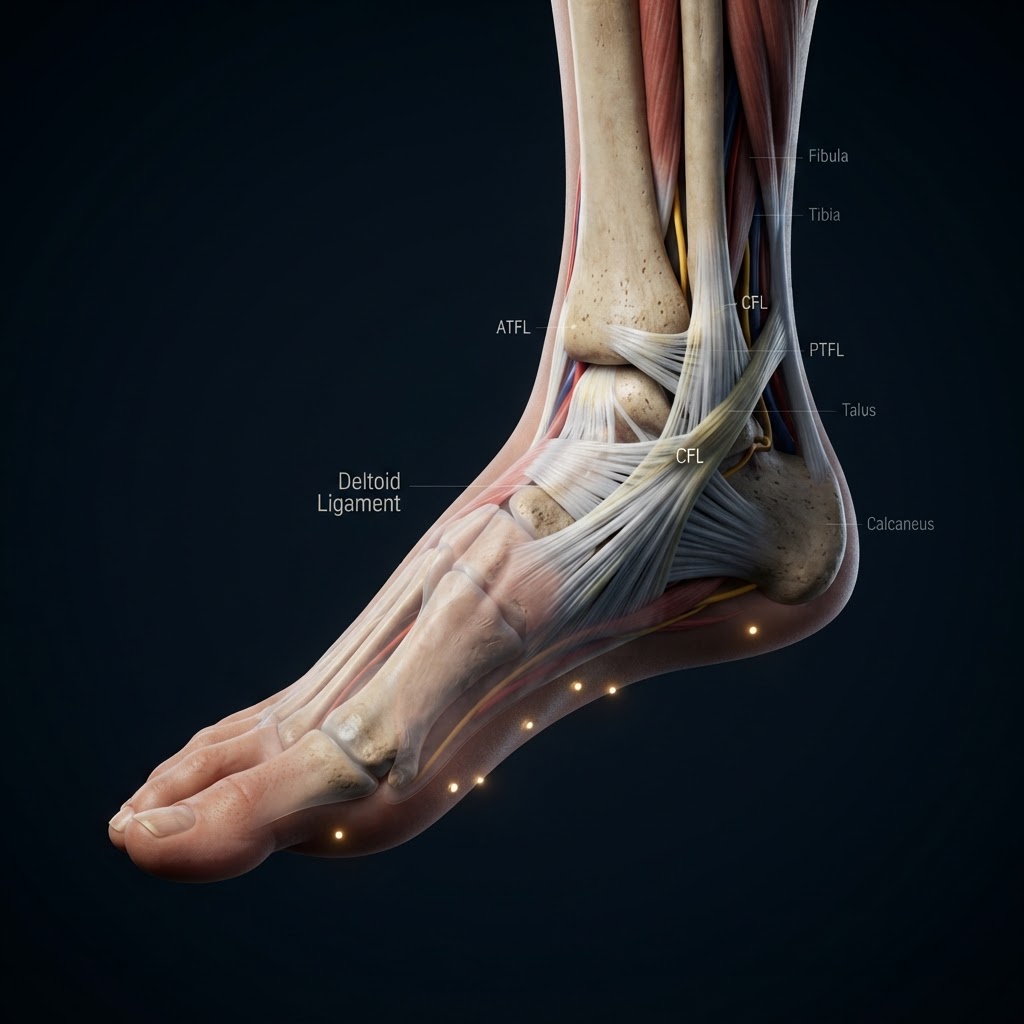
Anyone can run in a straight line. The athletes who dominate field sports — soccer, rugby, Gaelic football, hurling — are the ones who can stop on a coin, change direction, and explode out of the cut. That ability isn't about footwork drills or ladder exercises. It's about ligaments.
When you cut, your body has to decelerate all of your forward momentum, redirect it, and re-accelerate in a new direction — often in under half a second. The muscle that does the braking is important, but the tissue that actually absorbs the force is the ligament.
The Physics of a Cut
Let's break down what happens in a single change of direction:
-
Plant phase. Your foot hits the ground at an angle. Your body weight plus momentum — often 3 to 5 times body weight in force — loads into the ankle, knee, and hip.
-
Braking phase. Your ligaments and tendons stretch under that load, absorbing the kinetic energy like a shock absorber. This is eccentric loading — the hardest work connective tissue does.
-
Transition. For a fraction of a second, you're stationary. All that absorbed energy is stored in the elastic tissue, ready to be released.
-
Push phase. The ligaments and tendons recoil, releasing stored elastic energy and propelling you in the new direction. This is the stretch-shortening cycle in action.
The athletes who cut fast and clean have ligaments that are stiff enough to store energy quickly and strong enough to absorb massive deceleration forces without yielding. The athletes who get injured have ligaments that either can't absorb the load (sprains, tears) or can't control the alignment (ACL injuries from valgus collapse).
Why Most Agility Training Fails
Here's the problem: most agility training focuses on the feet. Ladder drills, cone drills, reactive light systems. These train the nervous system to move the feet quickly, but they do almost nothing for the ligaments that actually have to handle the forces.
An athlete who can dance through a ladder at lightning speed but has underprepared ligaments is an athlete who will cut during a game, load 4x body weight through an ACL that isn't ready, and hear the pop.
The real agility training happens at the tissue level.
Building the Ligament for Cutting
Eccentric strength first
Before you do any cutting or plyometric work, your ligaments need to be able to absorb force. Slow eccentrics — step-downs, Nordic curls, single-leg landings from low heights — build the braking capacity. If you can't decelerate slowly, you can't decelerate fast.
Isometric holds at the cut angle
The position your body is in during a cut — knee bent, hip loaded, slight trunk lean — is the position you need to be strong in. Isometric holds in that exact posture build ligament stiffness where it matters most.
Reactive plyometrics
Once the tissue can absorb and hold, you train it to release. Depth drops into immediate lateral jumps, single-leg bounds with direction changes, and reactive cutting drills build the stretch-shortening cycle in the specific pattern of agility.
Progress to unplanned cutting
Planned cuts are safe. Unplanned cuts — reacting to a defender, a ball, a whistle — are where injuries happen because the nervous system can't pre-brace. The ligaments have to handle the load on their own. This is the final progression, and it should only happen after weeks of planned preparation.
The Asymmetry Problem
Here's something most coaches miss: almost every athlete has a dominant cutting direction. Right-footed athletes prefer to plant and push off the left foot. Over years of training, the left-side ligaments become stronger and stiffer than the right.
This asymmetry is invisible until it isn't. The athlete cuts to their weak side, the ligaments aren't prepared, and the injury happens. The I Am 900 sensor system detects these asymmetries — measuring the load distribution between left and right chains during cutting movements, flagging the weak side before it becomes an injury.
The Takeaway
Agility is a ligament quality, not a footwork skill. If you want to cut faster, you need to build the tissue that brakes, holds, and redirects force. Train eccentrics. Train isometrics at cut angles. Train reactive plyometrics. And measure your asymmetries before they measure you. The fastest athletes aren't the ones with the quickest feet — they're the ones whose ligaments can handle the forces that speed creates.