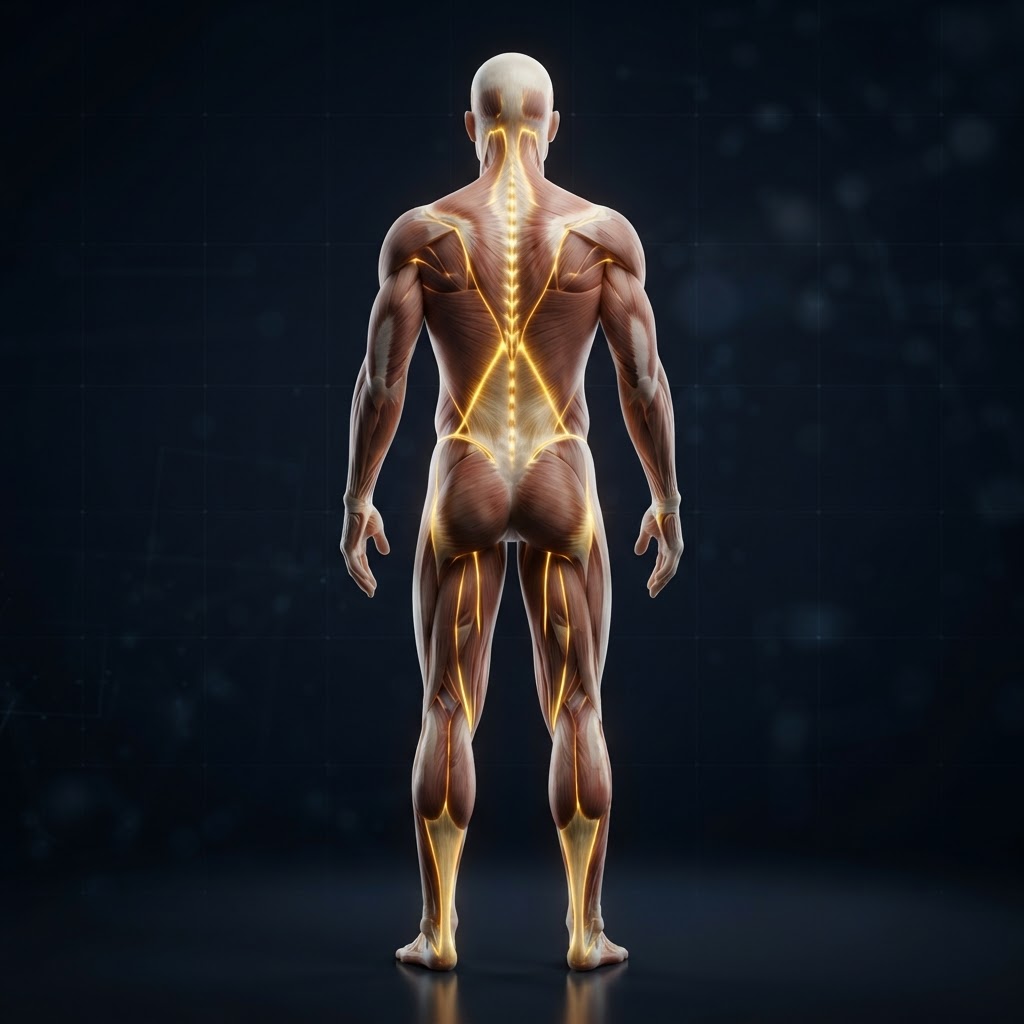
"Movement" is not a single quantity. It is a set of measurable variables — and the first question of any measurement system is which variables its instruments can legitimately record.
Here is the I AM 900 measurement vocabulary, variable by variable.
Pressure
What it is: force over an area of contact — how much force is recorded at a measured surface.
Which instrument records it: the I AM 900 Sensor Sling records pressure through its sensor zones, where the instrument configuration supports it. A pressure mat records ground and contact pressure at the measured surface.
What it is not: pressure at a Sling zone or mat surface is not pressure inside a joint, and not a direct reading of ligament load.
Distribution
What it is: how recorded pressure is organised — which areas take more, which take less, and how the organisation changes during the task.
Which instrument records it: both the Sensor Sling (across its sensor zones) and the pressure mat (across its contact surface). The two describe different surfaces.
Loading
What it is: the load applied through the task — including left/right loading and how it is shared over time.
Which instrument records it: the pressure mat records ground/contact loading directly; the Sensor Sling records the response at its measurement locations as loading progresses.
Angle / Orientation
What it is: orientation information — the measured angle or orientation of the instrument as the body moves.
Which instrument records it: the Sensor Sling, where supported by the sensor configuration.
What it is not: a joint-angle goniometer reading, and not a diagnosis of alignment.
Speed / Rate of Change
What it is: how quickly a measured variable changes — where the instrument configuration supports it.
Which instrument records it: the Sensor Sling, where supported. Not every assessment measures speed; the measurement set is chosen to fit the question.
Timing
What it is: when measurable events occur during the task.
Which instrument records it: the Sensor Sling's sensor-zone response over the course of the task; where used, the pressure mat's contact timeline.
Sequence
What it is: the order in which measurable events occur — which response follows which.
Which instrument records it: the Sensor Sling, by comparing sensor-zone responses across the task's timeline.
Repeatability
What it is: how consistently the response is reproduced across comparable trials.
Which instrument records it: any of them — repeatability is a property of the comparison, not a sensor. It is what makes a single measurement meaningful and a baseline-to-retest comparison legitimate.
Movement variability itself is a studied property of human movement — variability and its relationship to pathology and skill is an established research area (Stergiou N, Decker LM. Human movement variability, nonlinear dynamics, and pathology: is there a connection? Human Movement Science, 2011).
Movement Response
What it is: the whole recorded pattern — the response the body produces during the task, read across the variables above.
Which instrument records it: the measurement set as a whole, alongside the person's own report of their experience. Neither substitutes for the other.
What None of These Variables Do
No variable above diagnoses anything. Pressure, distribution, angle, timing, sequence, repeatability and loading are descriptions of the physical response. They do not identify pathology, directly measure ligament strain, or predict injury.