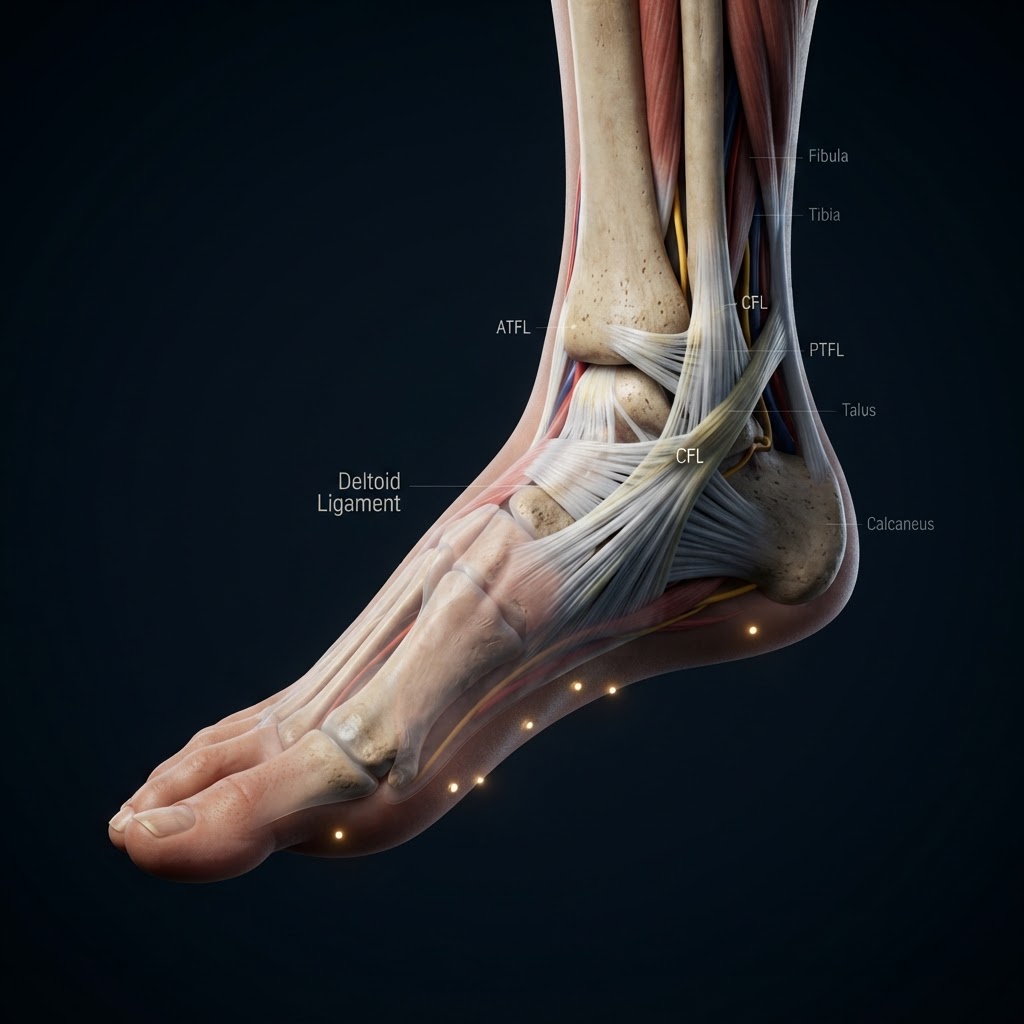
Ankle and Foot Loading in Sport: Pressure, Timing and Repeatability
The foot is where the athlete meets the ground — which makes it one of the most measurable places in sport. Measuring how runners contact the ground is not a new idea: ground reaction forces in distance running were being recorded and characterised in the biomechanics literature decades ago (Cavanagh & Lafortune. Ground reaction forces in distance running. Journal of Biomechanics, 1980). The question I AM 900 asks is the individual one: what does this athlete's loading response look like, and what changes after calibration?
For the anatomy underneath — the ligament system of the foot and ankle — see Barefoot Running and the Foot's Ligament System and How Barefoot Running Strengthens the Ankle's Collateral Ligaments.
The Foot Is Where Loading Becomes Visible
Knee and hip loading happen above a structure that is hard to instrument directly. The ground contact is different: it is the one interface where pressure and loading can be recorded directly. That is why foot and ankle loading is often where a measurement-led assessment starts.
Start With the Baseline Task
The baseline is a defined task — a set distance run, a shuttle, a jump-and-land sequence — performed under the same conditions each time. The athlete's current response is recorded across the measurements below, alongside what they report.
Ground Loading and the Pressure Mat
Where used, the pressure mat records ground/contact pressure and loading information for the task: when the foot loads, how load rises and falls through contact, and the total loading pattern recorded for each contact.
Pressure Distribution During Running
The mat also records how pressure is distributed across the contact — the recorded pressure pattern across the foot during the task. Distribution is a measured record, not a verdict. It does not imply anything about injury risk on its own, and it is not interpreted here as predicting injury.
Where the Sensor Sling Fits
The I AM 900 Sensor Sling records supported physical measurements at Sling measurement locations — where the instrument configuration places it for the task, it records sling pressure, pressure distribution across the relevant sensor locations, and orientation information supported by the configuration. The Sensor Sling itself measures pressure; the mat measures at the ground. Where both are used for the same task, they provide different measurements relating to the same defined task — complementary, never combined into one score. See Sensor Sling vs Pressure Mat.
Timing, Sequence and Left/Right Differences
When the measurable events occur, and the order they occur in, are recorded for the task. Where both sides are measured, left/right differences in the recorded response are information — a difference is not automatically a problem, and an asymmetry in recorded pressure is not evidence of cause. It is a finding to compare, and possibly to re-compare after a change.
Repeatability Before Interpretation
Before any left/right or baseline/retest comparison is meaningful, the recorded response has to be repeatable across comparable trials. Reliability is a recognised concern in sports-medicine measurement generally (Atkinson & Nevill. Statistical methods for assessing measurement error in variables relevant to sports medicine. Sports Medicine, 1998). Repeatability is treated here as a measured variable, not an assumption.
Baseline, Retest and What Changed
After a practitioner-directed calibration — a defined change to the input or conditions — the same task is repeated under the same conditions. The comparison is baseline against retest: what changed in the recorded pressure, distribution, timing and sequence. The difference describes the response. It does not establish why it changed, and it is not a guarantee of performance or injury outcomes. The wider framework is on the method page, the calibration process at /calibrate, and the sport pathway at /sport. For the instrument itself, see the I AM 900 Sensor Sling.