What Is Patellar Tendinopathy?
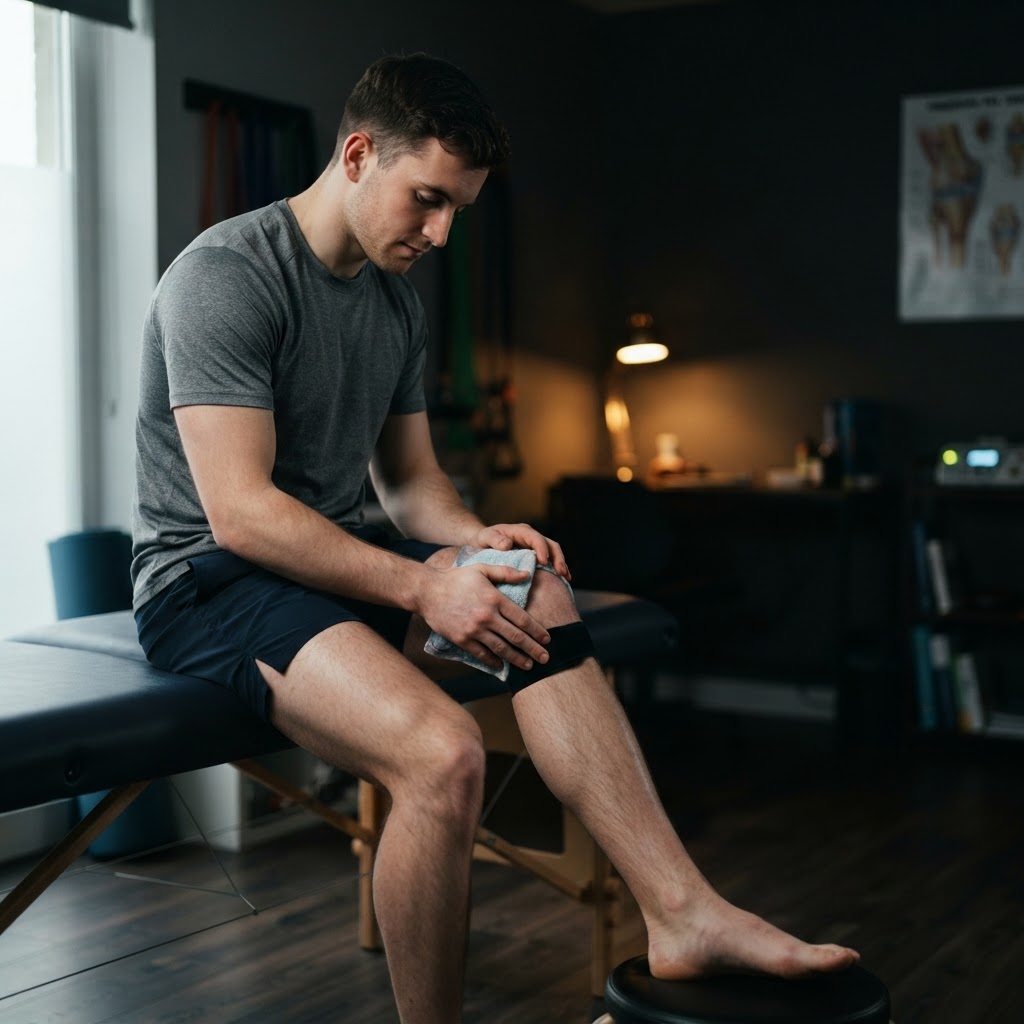
Patellar tendinopathy — often called "jumper's knee" — is pain just below the kneecap where the patellar tendon attaches to the shin. It's common in Irish sports: GAA, basketball, volleyball, and athletics all demand repeated jumping and landing.
But it also affects people who don't jump at all. The real cause isn't jumping — it's load that exceeds the tendon's capacity to recover. Understanding this distinction changes everything.
The Ligament and Tendon System
Your knee is a hinge joint stabilised by four major ligaments:
- Anterior cruciate ligament (ACL): Prevents the tibia sliding forward
- Posterior cruciate ligament (PCL): Prevents backward sliding
- Medial collateral ligament (MCL): Resists inward force
- Lateral collateral ligament (LCL): Resists outward force
The patellar tendon — technically a ligament, since it connects bone to bone — transmits the force from your quadriceps to your shin. When this tendon is overloaded, it develops micro-tears that don't fully heal, creating chronic pain.
Why Tendinopathy Develops
Tendinopathy isn't a sudden injury. It's an accumulation. The tendon's load capacity is exceeded over weeks or months:
- Training spikes: Suddenly increasing training volume without gradual progression
- Biomechanical compensation: Tight hips, weak glutes, or flat feet shift extra load to the patellar tendon
- Ligament chain imbalance: If the knee ligaments are asymmetric in tension, the patellar tendon takes uneven load
- Recovery deficit: The tendon needs 24-48 hours between high-load sessions. Without it, micro-tears accumulate.
The Metacognitive Recovery Approach
Step 1: Understand the Pain Stage
Tendinopathy has two phases:
- Reactive: Recent onset, the tendon is swollen and angry. Load must be reduced.
- Degenerative: Long-standing, the tendon has changed structure. Controlled load is the treatment.
Which stage are you in? This determines your approach. Reactive tendinopathy needs rest and gentle movement. Degenerative tendinopathy needs progressive loading.
Step 2: Feel the Load Distribution
When you squat, jump, or climb stairs, which part of your knee takes the load? Can you feel whether it's centred or偏向 one side? This awareness helps you identify the biomechanical compensation driving the tendinopathy.
Step 3: Progressive Loading
The counterintuitive truth about tendinopathy: rest alone doesn't cure it. Tendons need load to remodel and strengthen. The key is the right amount of load:
- Start with isometric holds (wall sits) to build capacity without movement
- Progress to slow, heavy resistance (Spanish squats, decline squats)
- Gradually reintroduce plyometric load (hopping, jumping)
- Let pain during exercise be a guide: 3-4/10 is acceptable, 5+ means back off
The Irish Sporting Context
- GAA and camogie: Repeated sprinting, cutting, and kicking load the patellar tendon asymmetrically
- Hurling: The single-sided swing creates rotational forces that strain the knee
- Rugby: Tackling and sprinting create high-impact loads
- Irish dancing: Repeated jumping demands exceptional tendon capacity
Action Steps
- Track your pain: Note when the pain is worst — during activity, after, or the next morning. This reveals your recovery capacity.
- Isometric holds: 5 × 45-second wall sits, 2-3 times daily. This builds tendon capacity without aggravation.
- Address the hips: Tight hip flexors tilt the pelvis forward, increasing patellar tendon load. Stretch daily.
- Strengthen the glutes: Strong glutes share the load with the knee. Weak glutes force the tendon to overwork.
- Feel the chain: When you walk, can you feel the force travel from your foot through your knee to your hip? Smooth force transmission means less knee strain.
The Mindset Shift
Patellar tendinopathy feels frustrating because it lingers. It doesn't resolve in days or weeks. But tendons are living tissue — they remodel, strengthen, and adapt when given the right stimulus.
The people who recover from tendinopathy are those who engage with the process. They track their pain, adjust their load, and feel their body's response. They don't passively wait for healing — they actively guide it.
Your patellar tendon has carried you through every step, sprint, and jump. It can recover — if you learn to load it wisely and listen to what it tells you. Every aware squat, every tracked pain response, every gradual progression is a step toward pain-free movement.
PAIN APPLICATION — KNEE / LOADING
This is a measurement example, not a case study.
For a defined loading task, an assessment may record:
- the reported pain score
- Sensor Sling pressure
- pressure distribution
- ground loading, where the pressure mat is used
- left/right loading
- timing
- sequence
- repeatability
- movement response
Tasks are defined from the person's current movement. The assessment compares the same defined task before and after the input changes:
ESTABLISH BASELINE → MEASURE → CHANGE INPUT → RETEST → COMPARE
A measured left/right difference is a description of the response. It does not automatically require correction — it is information for the practitioner's next decision.
Why Establish a Baseline Before Trying to Change Pain? sets out how the comparison works.
For the measurement layer around knee pain — reported pain and physical loading compared at baseline and retest — see Knee Pain and Loading: Measuring the Physical Response.