Knee Pain and Loading: Measuring the Physical Response
Knee pain is reported. Loading is measured. Keeping the two apart is what makes both of them useful — and it is the distinction this article applies throughout: the pain score is the person's reported experience; the physical measurement is what the instrument records. Neither automatically explains the other, and both can be compared between baseline and retest.
Start With the Baseline
The baseline is a defined knee-loading task — a squat-and-rise, a step-down, a walk sequence — performed the same way each time. Two records are made: how the person reports their pain, and how their body currently moves and loads during the task. The person becomes their own comparison. See Why Establish a Baseline Before Trying to Change Pain?
What Can the Sensor Sling Measure?
The I AM 900 Sensor Sling records supported physical measurements at Sling measurement locations. Where the instrument configuration supports it for the task: sling pressure — distributed pressure recorded at relevant Sling measurement locations; pressure distribution — how the recorded pressure is distributed across the relevant sensor locations through the task; angle / orientation where supported; timing — when measurable events occur; sequence — the order in which they occur; and repeatability — how consistently the recorded response appears across comparable trials.
Repeatability matters before any comparison is made: reliability is a recognised concern in measurement relevant to sports medicine and rehabilitation generally (Atkinson & Nevill. Statistical methods for assessing measurement error in variables relevant to sports medicine. Sports Medicine, 1998). Repeatability is treated here as a measured variable, not an assumption.
Ground Loading and Left/Right Differences
Where used, the pressure mat records ground/contact pressure and loading information for the same task. The Sensor Sling itself measures pressure at its own locations; where both are used, they provide different measurements relating to the same task and are never combined into one score (Sensor Sling vs Pressure Mat).
Where both sides are measured, left/right loading differences are recorded as observations. A difference between the sides is information to compare — it is not automatically the cause of the pain, and an asymmetry in recorded loading is not presented as explaining the reported pain.
What Measurement Does Not Claim
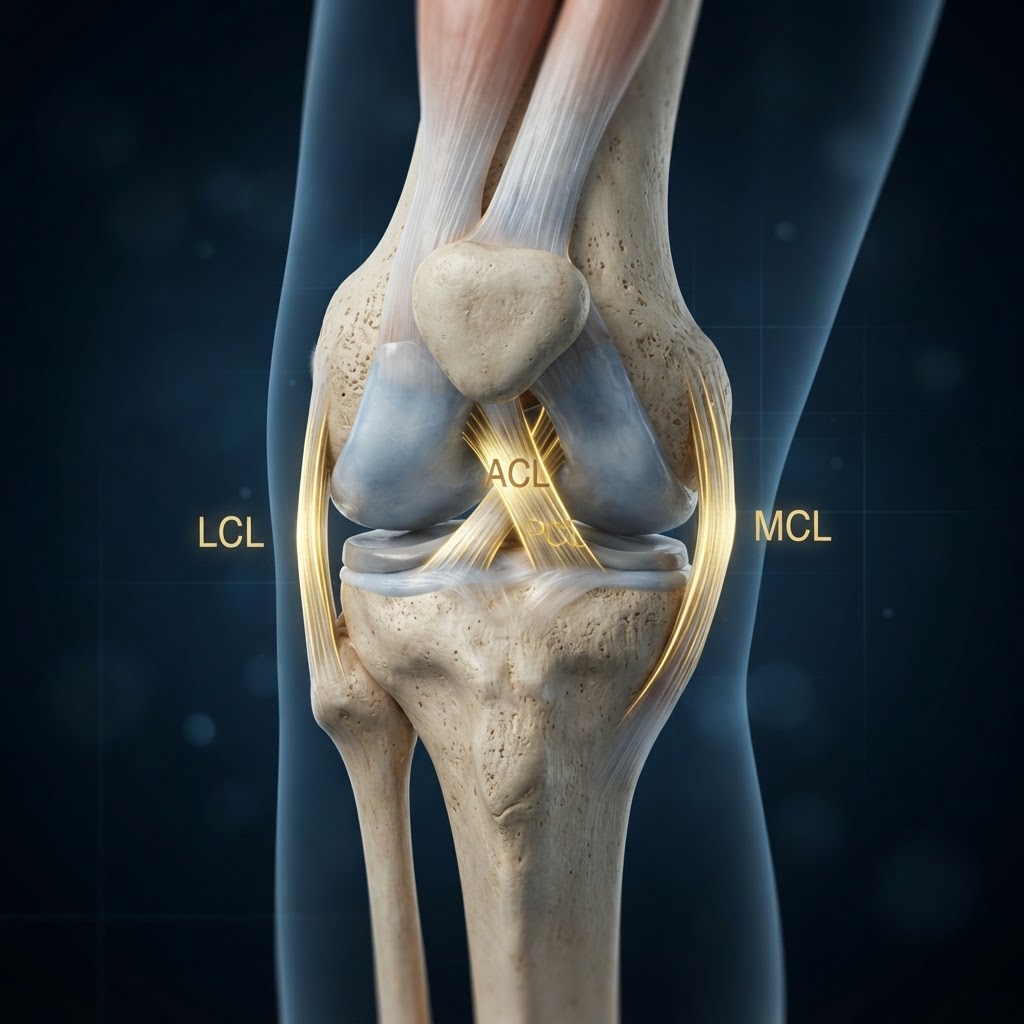
The measurement set above does not detect ACL, MCL or LCL pathology, does not diagnose cartilage condition, does not predict injury, and does not identify the cause of pain. For the anatomical context of knee structures, see Knee Pain and Patellar Tendinopathy and the MCL and LCL anatomy article. Diagnostic questions belong with qualified clinical assessment, which remains a separate process.
Change the Input, Retest, Compare
Calibration applies a defined, practitioner-directed change to the input or conditions (what calibration means). The same task is then repeated under the same conditions, and the retest is compared with the baseline on both tracks: the reported pain and the physical measurement. The difference is information about the response. It does not by itself establish why anything changed, and it is not a guarantee of pain improvement.
Where This Fits
The pain pathway — including recorded outcomes — is at /pain; the method at /method; the calibration process at /calibrate; the instrument at I AM 900 Sensor Sling. Related reading: Pain Score vs Physical Measurement, Pressure Distribution and Pain, Using the I AM 900 Sensor Sling to Measure Physical Response.