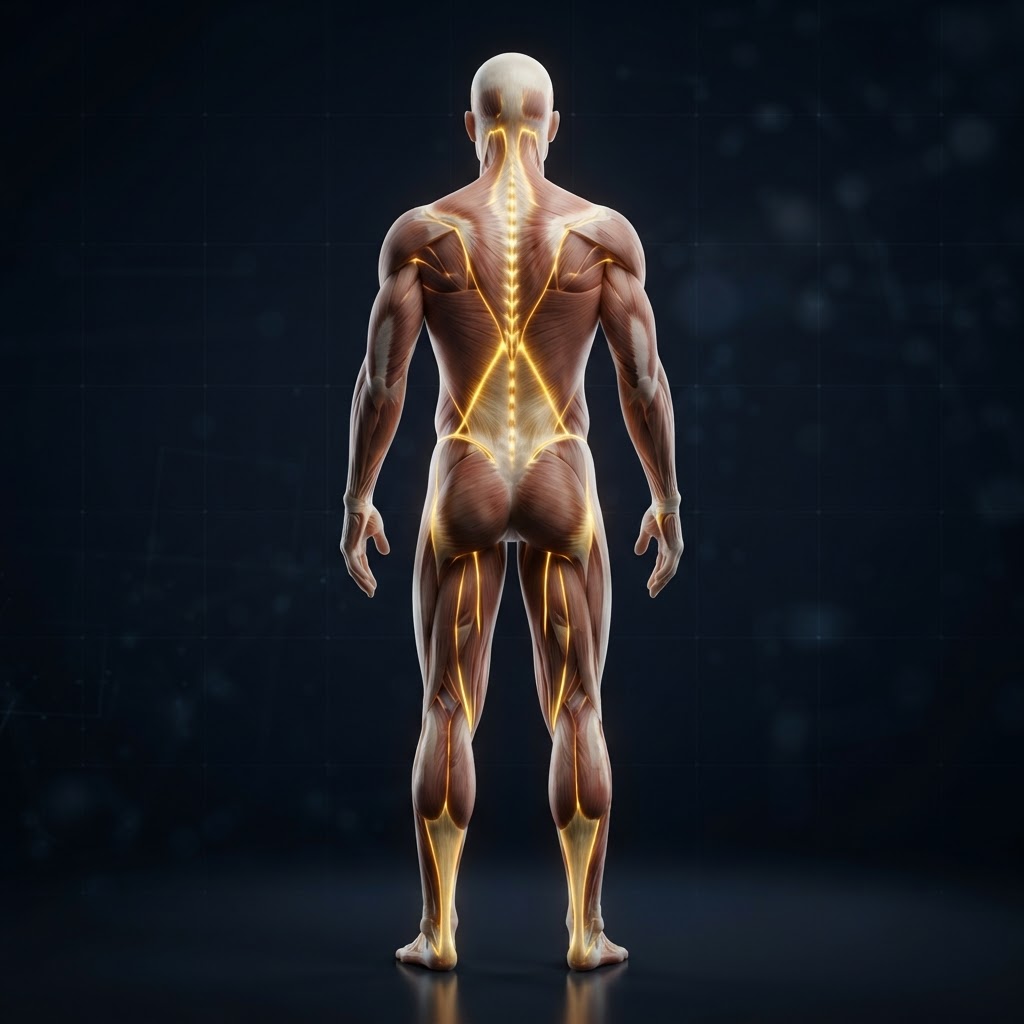
Two instruments are used within I AM 900 measurement. They record different surfaces — and they answer different questions.
SENSOR SLING ≠ PRESSURE MAT
What the Sensor Sling Measures
The I AM 900 Sensor Sling is a fabric-supported measurement device worn around the region being assessed. It records — where supported by the instrument configuration:
- distributed Sling pressure — how force is organised across the Sling's sensor zones
- pressure distribution — how that recorded pressure is spread across the relevant sensor locations
- angle / orientation — the Sling's measured orientation as the body moves
- timing — when measurable events occur
- sequence — the order in which measurable events occur
- repeatability — whether the response is consistent when the task is repeated
- speed / rate of change — where supported
- multi-sling measurement — where multiple Sensor Slings are genuinely used, relevant measurements at different locations may be recorded during the same defined task
Its surface is the body — the region the Sling is worn around.
What the Pressure Mat Measures
A pressure mat records a different surface entirely: the ground or contact surface.
- ground / contact pressure — the pressure recorded at the mat's surface during the task
- left / right loading — how load is shared between sides
- distribution over time — how the loading pattern changes as the task progresses
Its surface is the ground or contact interface — not the body.
Why the Difference Matters
The same movement task produces both kinds of information:
- what the body-side Sling records about the region it is worn around
- what the ground-side mat records about the contact interface
These are different information about the same task. A change in one does not have to match a change in the other — and each is read on its own terms.
Complementary, Not Composite
Where both instruments are used in an assessment, their results are presented as complementary information. They are never combined into an invented composite score — a single number that pretends one instrument saw what only the other could.
Nor is either instrument a substitute for the person's report. What the person reports about their experience is recorded alongside the measurements, and neither substitutes for the other.
What Neither Instrument Does
No measurement here diagnoses anything. Neither instrument:
- identifies the source of pain or pathology
- directly measures ligament strain
- predicts injury
- measures pain intensity or psychological state
They record the physical response. That is their job — and it is a real, useful job when it is measured against a baseline and retested.