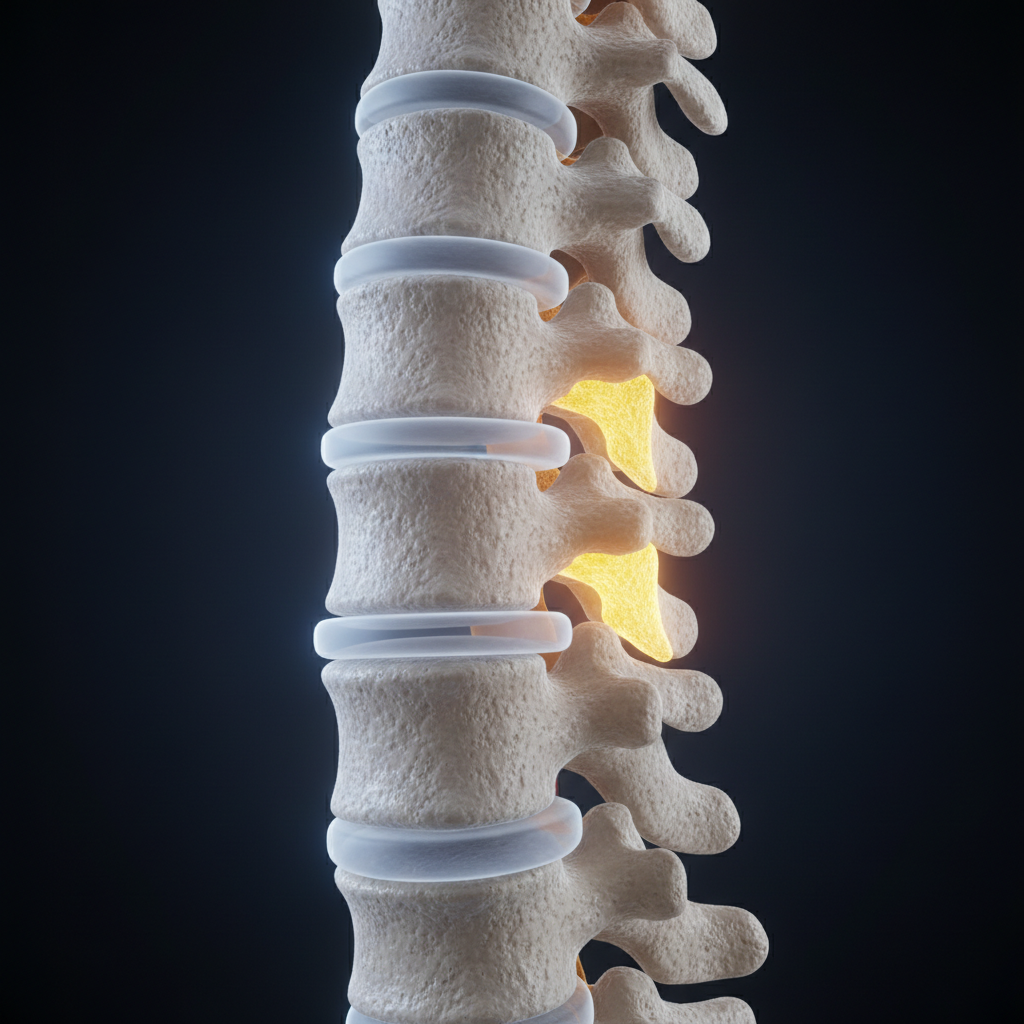
The Biomechanical Reality of Spinal Compression
Every time an athlete initiates contact, absorbs a hit, or loads the bar for a heavy lift, a massive axial load travels directly down the cervical spine. While helmets and bracing protect the skull, the force is absorbed by the vertebrae and the supporting soft-tissue structures. Over a career, this relentless micro-trauma leads to accelerated cervical disc degeneration — specifically at the C4–C5, C5–C6, and C6–C7 segments.
When these discs lose height, the space for passing nerves narrows significantly. For an athlete, this translates directly into chronic neck stiffness, radiating upper-body pain, and the dreaded "stinger" — a burning, electrical shock that strips arm strength on the field.
How Neck Instability Radiates Pain Down the Kinetic Chain
The cervical spine does not work in isolation. When the deep ligaments of the neck lose tension, the entire upper kinetic chain compensates: the trapezius locks down, the shoulder blade stops tracking cleanly, and the throwing or lifting arm loses its stable base. What feels like a shoulder problem often begins as a cervical ligament problem.
Why Standard Core and Neck Training Fails
Most athletic programmes attempt to solve neck pain with shrugs, isometric neck holds, and heavy trap work. This approach misses the root cause. Muscles are tertiary stabilisers — they cannot hold the spine in alignment if the deep anterior longitudinal ligament (ALL) and posterior longitudinal ligament (PLL) have suffered micro-tears and laxity from repetitive impacts.
When these ligaments stretch or become unstable, the body responds by locking down surrounding muscles in a perpetual state of protective guarding. Stretching those muscles or building larger trap bulk simply masks the structural deficit, leaving the disc vulnerable to herniation during high-velocity impacts.
The 900 System Solution: Rekindling Neck Elasticity
Our system focuses on restoring the natural tensegrity of the neck. By systematically identifying ligamentous instability and using advanced neurological recalibration, we encourage the deep cervical ligaments to tighten and re-stabilise the spinal column.
Re-tensioning targets the compressive shear stress on the cervical discs and the nerve pathway irritation associated with stingers. Any change in rotational neck range of motion and upper-extremity power is examined on retest, against the athlete's recorded baseline — individual results vary.
How We Measure It
We don't guess at cervical instability. Our latency assessment maps proprioceptive delay across the neck and shoulder chain, while tension data from the sling sensors reveals exactly where the ligamentous network has gone slack. You see the deficit in numbers — and you watch it close as the chain re-tensions.
Take the Next Step
Is your spinal disc degeneration caused by unrecognised ligamentous laxity? Measure your structural deficit with our 900 Stability Assessment and see exactly where your 20% is hiding.