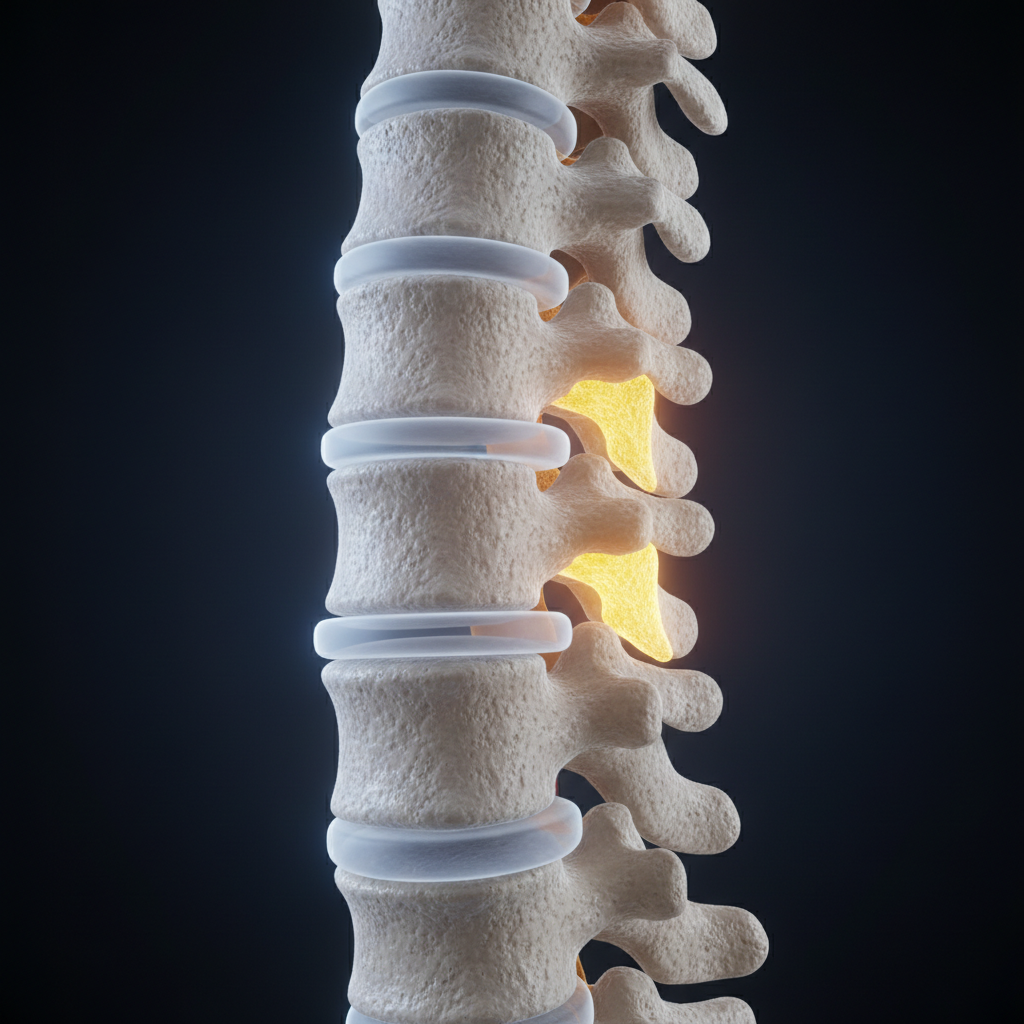
How L4–S1 Disc Compression Destroys Your Drive Phase
Explosive power originates in the ground, transfers through the hips, and drives through the core. If you suffer from lumbar disc degeneration, that power transfer is shattered. Athletes coming out of a low stance or making hard lateral cuts put immense rotational torque and compression on the L4–L5 and L5–S1 lumbar joints.
As these discs degrade, they cause localised inflammation, severe lower-back stiffness, and radiating sciatica down the glutes and hamstrings. For a high-performance athlete, this means an immediate loss of hip extension, slower sprint times, and an inability to anchor against an opponent.
Fixing the Root Cause of L4–S1 Structural Failures
The misconception in sports medicine is that core strength fixes disc issues. It does not — not when the primary ligamentous anchors are compromised.
The Illusion of Core Strength
Players are constantly told to perform more planks, deadlifts, and core bracing to cure back pain. However, if the iliolumbar ligament and the supraspinous ligament are compromised, no amount of abdominal bracing will keep the vertebrae stable during a violent block, tackle, or lift.
When these primary ligamentous anchors suffer micro-laxity, the vertebrae slip out of their optimal tracking path during movement. This creates an uneven, destructive grinding force on the lumbar discs. Your nervous system recognises this unstable "wobble" and immediately down-regulates the firing of your glutes and hamstrings to protect the spine — robbing you of your power baseline.
Reclaiming Your 20% Edge
The 900 System approaches lumbar disc issues from a structural engineering perspective. We isolate and map the exact ligamentous tissue responsible for the micro-instability. By targeting and reconditioning these dense connective-tissue walls, we pull the lumbar spine back into perfect alignment.
This decompresses the L4–S1 discs organically, permanently shuts off neurological muscle guarding, and returns your hips to full capacity — yielding a measurable 20% improvement in your explosive drive phase and hip-extension metrics.
How We Measure It
Our latency assessment quantifies the proprioceptive delay across your lumbar chain, and the sling's fabric pressure sensors read the tension differential between left and right sides of your spine. The deficit that's been invisible on a standard MRI shows up as a number — and the re-tensioning protocol shows it closing.
Read Next
- Chronic Lower Back Pain in Ireland: Breaking the Cycle
- Bulging Disc Recovery: Rebuilding Your Spine from Within
- The I AM 900 Pain Pathway
For the measurement layer around lower back movement — what can be recorded at baseline and retest, without a diagnosis — see Lower Back Pain and Movement: What Can We Measure?.