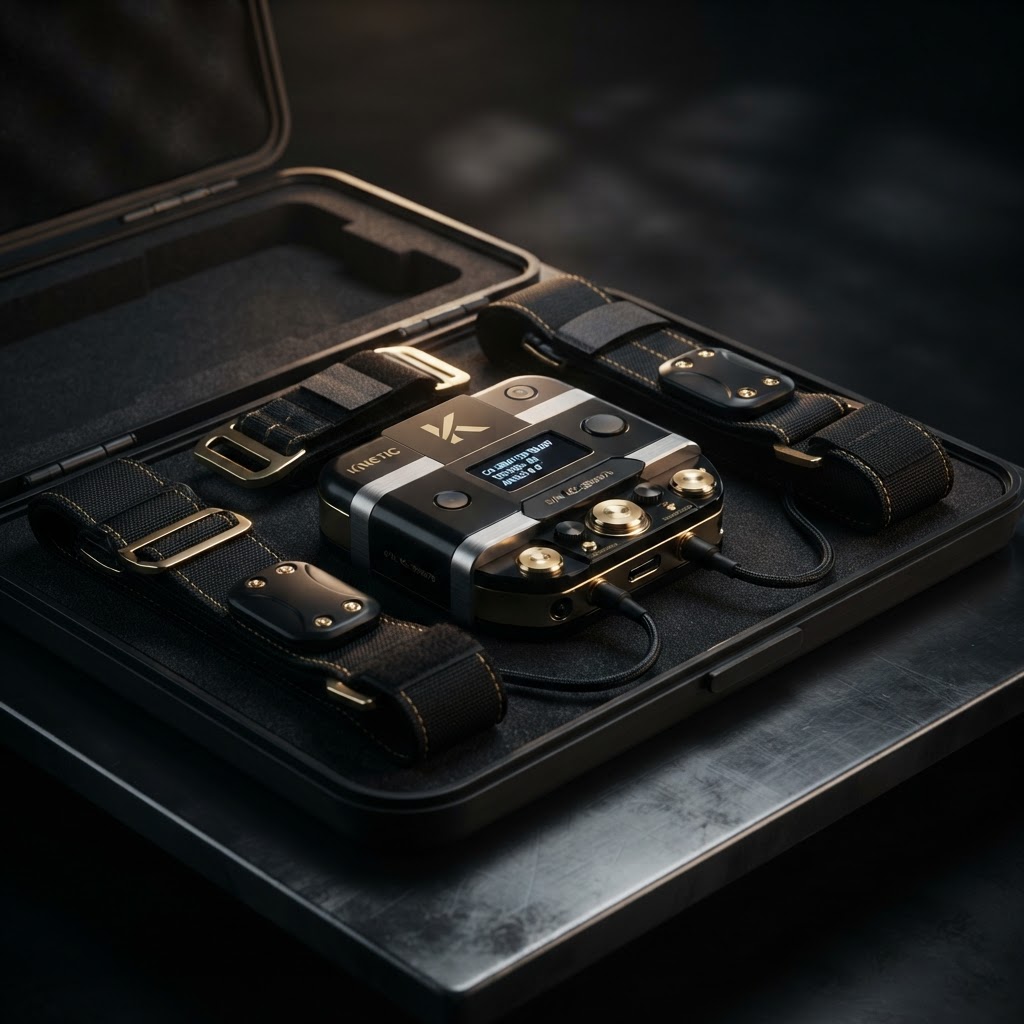
Every measurement instrument earns trust in two ways: by being precise about what it records, and by being equally precise about what it does not. This article is the second half done properly — because an instrument that claimed to do everything would be claiming too much to be believed.
WE DON'T ASK A SENSOR TO TELL US YOUR STORY. WE USE MEASUREMENT TO UNDERSTAND THE PHYSICAL RESPONSE HAPPENING NOW.
What the Sensor Sling can measure
Where the measurement is supported by the instrument and configuration, the Sling records:
- Distributed Sling pressure — force through the supported structure
- Pressure by sensor zone — how that force distributes across individual sensor zones
- Proximal / distal Sling pressure, where applicable — how load is shared along the supported structure
- Sling angle — orientation within the movement
- Angle change — how orientation shifts as the response unfolds
- Rate / speed of change — how quickly a measured value changes
- Timing — when a measurable change occurs
- Sequence — the order in which measurable changes occur
- Repeatability — whether the same pattern appears under comparable repetition
- Relationships between multiple Sensor Slings — how measurements from more than one Sling behave together
- Relationships with pressure-mat measurements — how Sling response relates to ground and contact loading
Each of these is a physical, recordable property of the response. None of them requires interpretation to exist — the instrument records them, and the recorded values are the same for every reviewer.
What the Sensor Sling does not directly measure
With equal clarity, the instrument does not directly measure:
- Memories
- Emotions
- Fear
- Psychological trauma
- PTSD
- Thoughts
- Intent
- The meaning of an experience
That list is not a disclaimer appended for safety. It is the honest boundary of what a physical sensor does. A sensor records physical values. Memories, emotions and meaning are not physical values, and no measurement in this system is presented as if it were one.
If a claim ever appears that the Sling "detects trauma" or "reads the body's memories," it is not this system's claim — and it should be treated with suspicion.
Three different kinds of information
The I AM 900 process deliberately separates three sources:
- Measurement provides data. The physical response, recorded through the Sling and pressure mat — specific, repeatable, and not explanatory on its own.
- Questions provide context. What happened, when it started, what changed, what the person can no longer do. Rich, personal, and not measurable by any sensor.
- Retesting provides comparison. The same measurement repeated under comparable conditions, so change can be demonstrated rather than described.
Confusing these sources is where systems go wrong: treating measurement as narrative, or treating narrative as measurement.
Why the boundary makes the system more useful, not less
A bounded instrument is a trustworthy one. Because the Sling claims only physical response measurement, everything it records can be compared cleanly — baseline against retest, session against session — without meaning drifting into the comparison.
That is why the calibration process is built around comparison rather than interpretation: the instrument does its bounded job, the practitioner supplies judgement, and neither pretends to be the other.
Where to go next
Read the measurement inside its operational context in The Method, see the instrument on the Sensor Sling page, or start at the Trauma Pathway. The closing position is the opening one, and it will not change:
THE SENSOR SLING MEASURES THE PHYSICAL RESPONSE. QUESTIONS ADD CONTEXT. RETESTING SHOWS WHAT CHANGED.