The Body Is Not a Collection of Parts — It Is a Chain
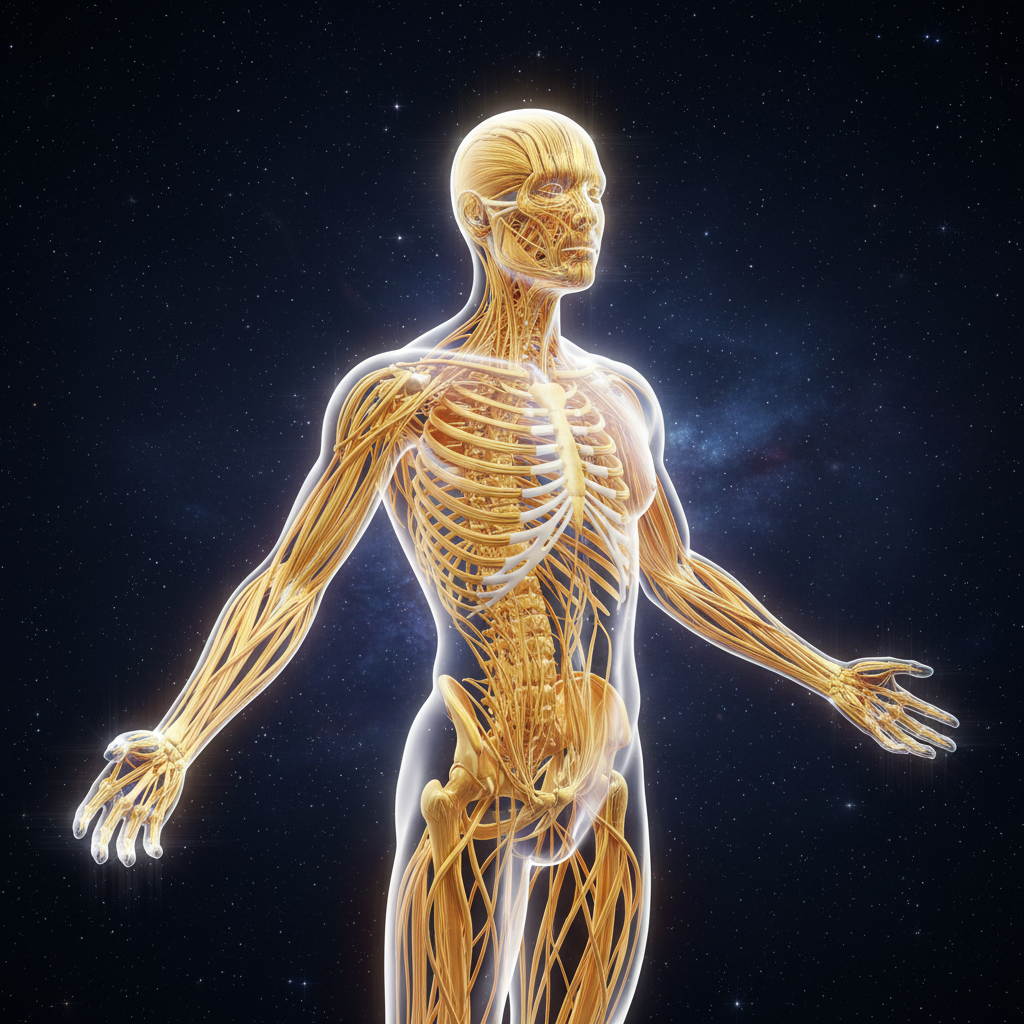
In sports medicine, there is a growing recognition that the body functions not as isolated joints, but as interconnected chains. Ligaments, tendons, and fascia form continuous tension networks that transmit force from one end of the body to the other. Understanding these chains is the key to whole-body performance enhancement.
The Posterior Ligament Chain
The posterior chain is the body's primary power-generating system. It runs from the plantar fascia of the foot, through the Achilles tendon, calf muscles, hamstrings, sacrotuberous ligament, thoracolumbar fascia, and up to the nuchal ligament at the base of the skull.
Key ligamentous connections in this chain include:
- Plantar fascia → Achilles tendon — the foot's arch to the heel
- Sacrotuberous ligament — connects the sacrum to the ischium, linking the lower limb to the pelvis
- Thoracolumbar fascia — the connective tissue network of the lower back
- Supraspinous and interspinous ligaments — connect the vertebrae
When an athlete sprints, this chain stores and releases elastic energy from the ground all the way up the body. A weakness or restriction anywhere in the chain reduces total power output.
The Anterior Ligament Chain
The anterior chain runs from the dorsal foot ligaments through the tibialis anterior, the inguinal ligament, the rectus abdominis, and the sternoclavicular and costoclavicular ligaments up to the shoulder.
This chain is critical for:
- Deceleration and absorption of landing forces
- Core stability and postural control
- Upper body reach and power in throwing and striking
The Lateral Chain and the Knee-Shoulder Connection
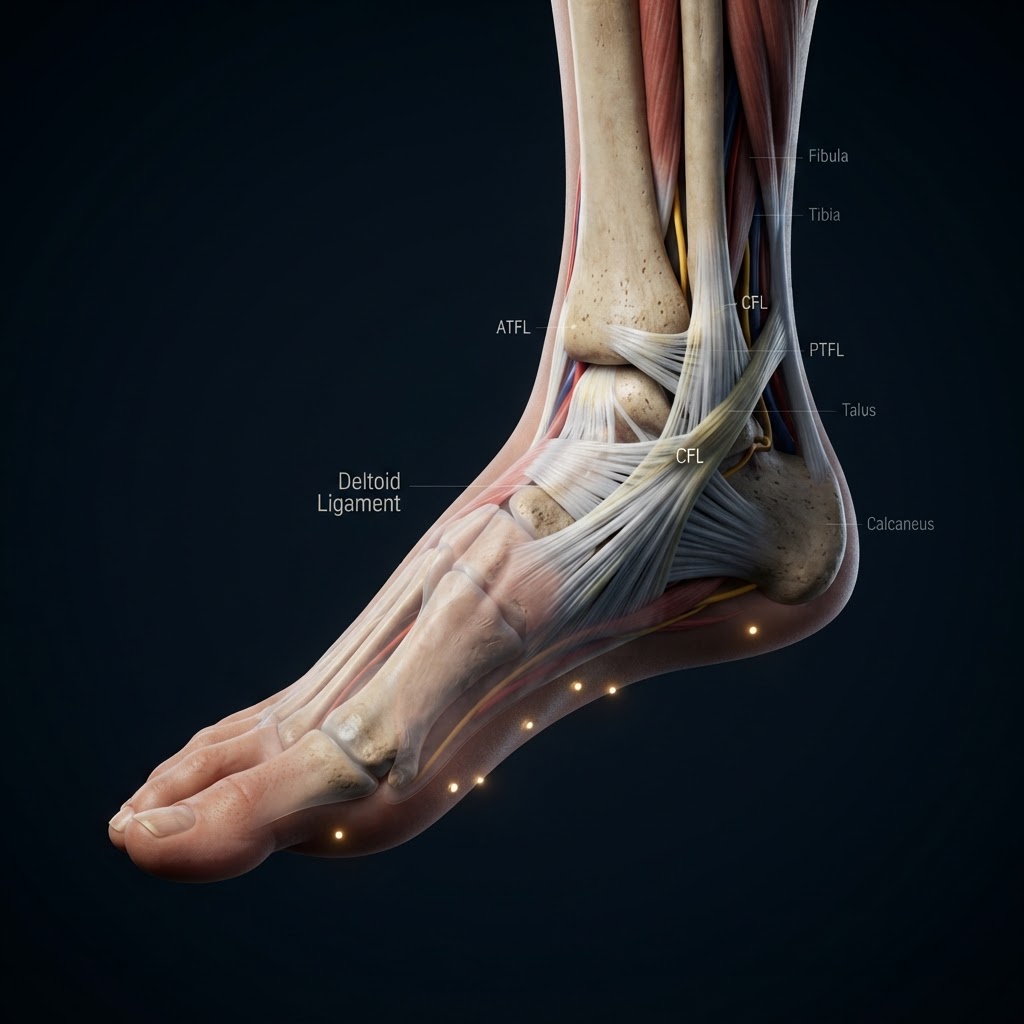
The lateral chain runs from the peroneal tendons and lateral ankle ligaments, through the iliotibial band, the lateral hip stabilisers, the oblique abdominal muscles, and the lateral shoulder structures.
This lateral chain is what allows an athlete to cut sharply without the knee collapsing. It is also what transfers rotational power from the lower body to the upper body — connecting the knee's cutting ability to the shoulder's throwing and striking power.
Why a Weak Knee Ligament Affects the Shoulder
Consider a GAA player cutting hard to the right. The lateral knee ligaments must stabilise the joint. If the knee's lateral stability is compromised, the body compensates by altering movement patterns — shifting weight, changing trunk position, modifying arm swing. These compensations:
- Reduce the power available for a hand-pass or strike
- Place the shoulder in a less optimal position
- Increase stress on the shoulder's ligaments
- Decrease accuracy and timing
This is why treating the shoulder without addressing the knee — or vice versa — often fails to deliver lasting results.
Enhancing the Complete Chain
Our approach to ligament enhancement is based on this chain principle:
- Map the entire chain — not just the symptomatic joint
- Identify weak links — where force transmission breaks down
- Enhance from the ground up — stable foot and ankle first, then knee, hip, spine, shoulder
- Integrate with movement — test the chain in sport-specific patterns
- Measure the result — quantify the performance gain
The I Am 900 Approach
Our sling system with fabric pressure sensors maps the entire ligament chain from shoulder to foot simultaneously. Combined with distal pressure sensors on the hands and feet, it creates a complete picture of how force flows through the body — revealing exactly where enhancement will deliver the greatest performance return.
This is the fundamental insight: 20%+ performance gains do not come from strengthening a single ligament. They come from optimising the entire chain — and our system was built to do exactly that.