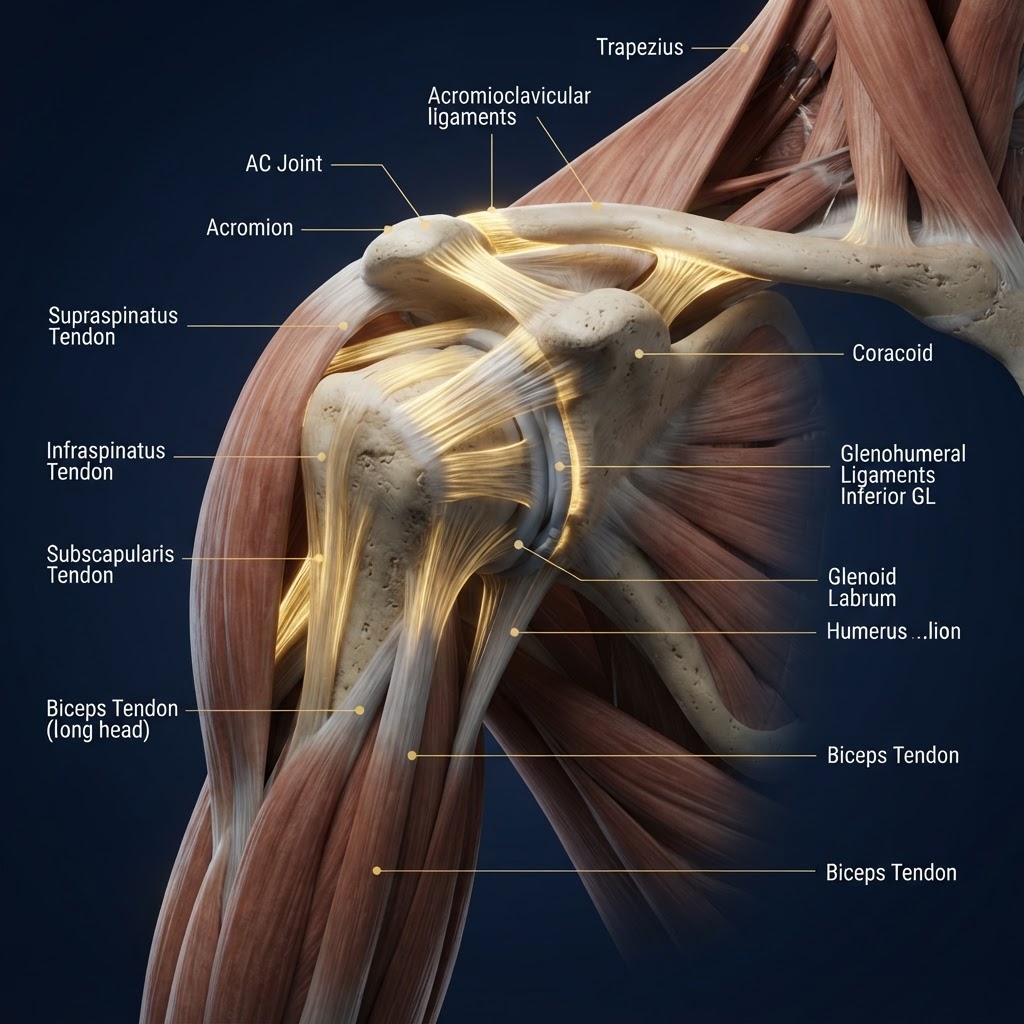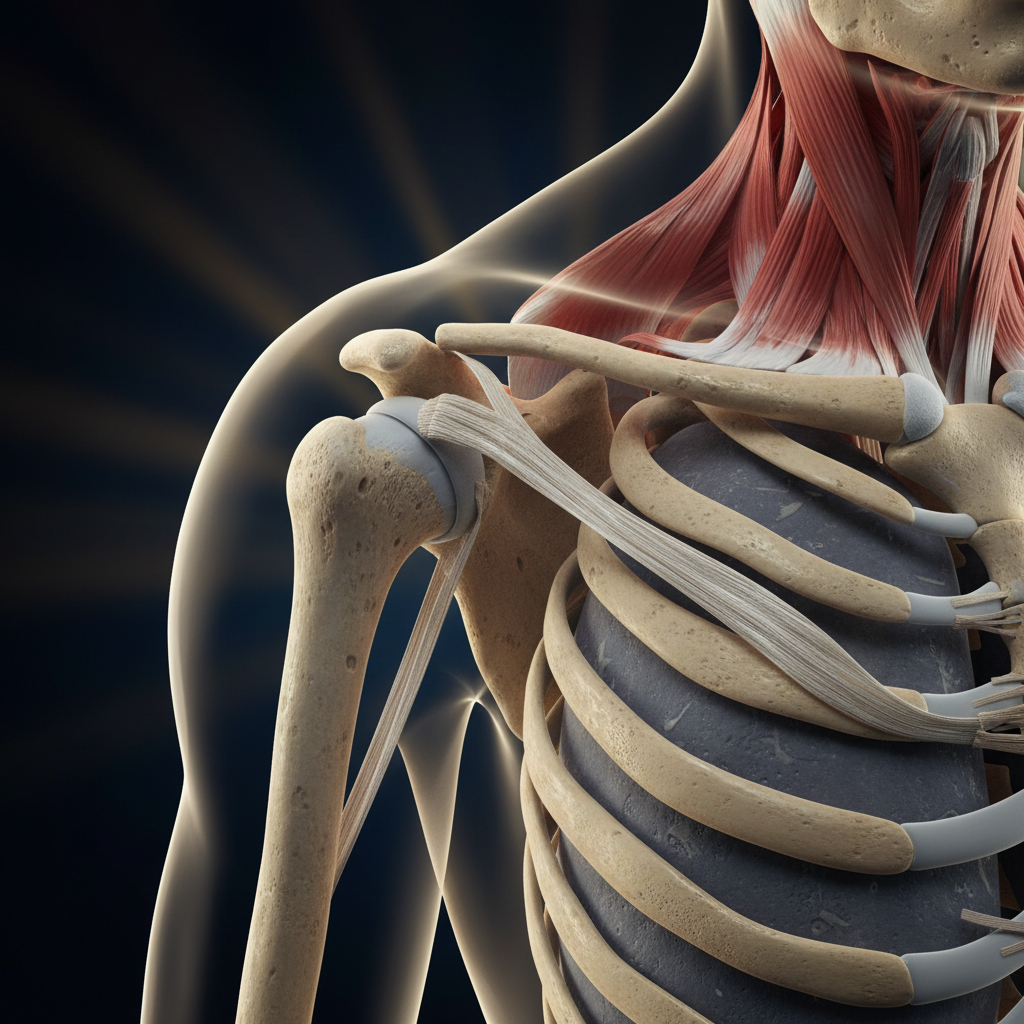
The Dynamic and Static Stabilisers of the Shoulder
Shoulder stability in throwing sports depends on two complementary systems working together:
- Static stabilisers — the ligaments and labrum that provide passive structural support
- Dynamic stabilisers — the rotator cuff muscles that actively control the joint
When throwing a sliotar in hurling, passing in GAA, or serving in tennis, both systems must function in perfect coordination. A failure in either leads to decreased performance and increased injury risk.
The Static Stabilisers: Glenohumeral Ligaments and Labrum
As covered in our AC joint article, the glenohumeral ligaments form a hammock beneath the humeral head. During throwing:
- The IGHL is under maximum tension in the cocking phase (arm back, externally rotated)
- The labrum deepens the socket and provides attachment for the ligaments
- The superior labrum anchors the long head of biceps, which contributes to stability
The Dynamic Stabilisers: The Rotator Cuff
The rotator cuff consists of four muscles whose tendons blend with the joint capsule and work alongside the ligaments:
- Supraspinatus — initiates abduction, compresses the humeral head into the socket
- Infraspinatus — primary external rotator, resists anterior translation
- Teres minor — assists external rotation, resists inferior translation
- Subscapularis — internal rotator, the anterior buttress of the joint
How They Work Together During a Throw
The throwing motion places extreme demands on the shoulder:
- Wind-up — the arm begins the motion; minimal stress
- Early cocking — the arm starts to externally rotate; the rotator cuff begins to stabilise
- Late cocking — maximum external rotation; the IGHL and anterior labrum are under peak tension
- Acceleration — the arm violently internally rotates; the rotator cuff fires maximally to decelerate and control
- Deceleration — the posterior cuff (infraspinatus, teres minor) works eccentrically to slow the arm
- Follow-through — the shoulder must dissipate the remaining force
Why Throwing Injuries Occur
Most throwing injuries happen in the late cocking and deceleration phases:
- IGHL strain or failure — from repeated extreme external rotation
- SLAP tears — the biceps-labral complex is stressed by the deceleration forces
- Internal impingement — the supraspinatus and posterior labrum are pinched at maximum external rotation
- Rotator cuff tears — from chronic overload or acute failure
Enhancing the Shoulder for Throwing
Optimising the throwing shoulder requires:
- Balanced rotator cuff strength — especially the external rotators, which are often neglected
- Posterior chain flexibility — tight posterior capsule limits internal rotation
- Scapular stability — the foundation for all shoulder movement
- Ligament conditioning — progressive loading of the glenohumeral ligaments
- Neuromuscular control — training the coordination between static and dynamic stabilisers
The I Am 900 Approach
Our sling system reads the tension distribution across the rotator cuff and glenohumeral ligaments during throwing motions. By identifying where the static-dynamic balance breaks down, we can guide targeted work whose effect is then measured and compared in a retest.
The shoulder is only as strong as its weakest link. Whether that link is a ligament, a tendon, or the neural coordination between them — our system measures it and tracks the response.
Sport Application — Throwing and Overhead Movement
This is a measurement example, not a case study.
For throwing, overhead sport and repeated arm movement tasks, the relevant measurement language is Sensor Sling pressure, angle and orientation, timing, sequence, repeatability and movement response.
The purpose is measurement and comparison — not a guarantee of throwing velocity, accuracy or durability.
The athlete's own recorded baseline is the reference: measure the response, change the input, retest the same defined task, compare what changed.
What Should You Measure in Sport? sets out the measurement vocabulary.
Keep Exploring
For the measurement layer of this topic — how pressure, angle and sequence are measured in overhead sport — see Shoulder Movement in Sport: Measuring Pressure, Angle and Sequence.